

This proposal is part of the weekly Giving America Series. Model it on the roadmap alongside all the other proposals at contributism.org/giving-america.
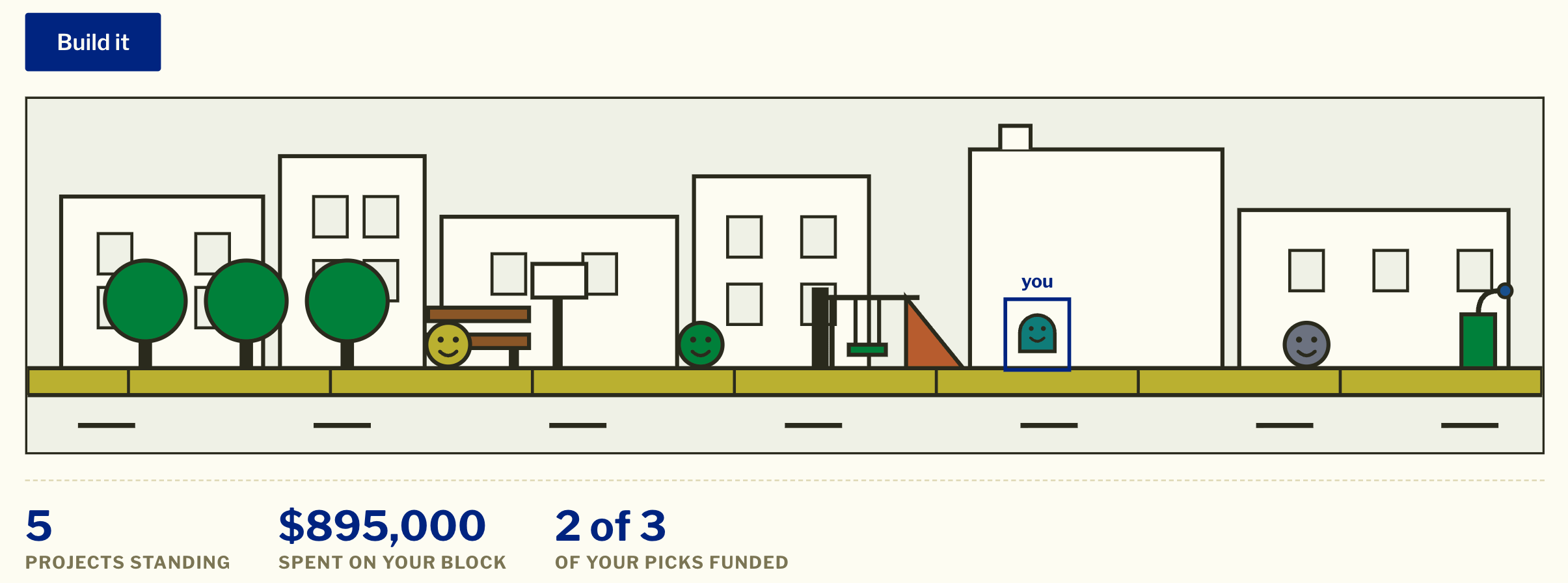
In 2011, four districts in New York City launched participatory budgeting, a process in which residents can decide how public funds are spent in their community. Now, it’s widespread in NYC for local physical infrastructure projects – usually around schools, libraries, streets – with the simple requirement that they cost at least $50,000 and will last at least 5 years.
Districts hold neighborhood meetings to collect ideas for community improvement projects. Idea collection is focused particularly on hard-to-reach communities, such as immigrants with limited English proficiency, youth, senior citizens, and public housing residents. Volunteers then research community needs and work with city agencies to turn ideas into concrete proposals.
As a resident, it’s a fun process. First, districts hold community meetings where residents brainstorm ideas and appoint volunteer delegates to shape them into proposals. Then, you get a description of a number of proposed projects in your neighborhood and get to choose, say, three of them that part of your community’s tax money will be spent on. Do you want to plant more trees on the streets? Build a lab for the school around the block? Buy an aquatic weed harvester for the local lake? While voting for your local politicians hopefully allows you to be indirectly involved in how the city spends your taxpayer money, it’s nice to feel like you are contributing directly to where some of it goes.
One of the coolest (and most contributist!) things about participatory budgeting in New York City is that anyone can participate. Regardless of incarceration status, citizenship, or age (you can vote even as young as 11!). If you live and pay taxes in the community, you’re able to help direct where some of those taxes go.
Proposal: Participatory Budgeting
When I think of what a contributist society looks like, I think it has to include participatory budgeting in some form. To me, the biggest question is – how much of the budget should be decided by participatory budgeting? A positive about the NYC example is that it directly impacts the immediate community you live in, the schools your kids go to, the streets you walk on every day. Someone in Staten Island isn’t voting for what should be done in the Bronx, and vice versa. I think some amount of participatory budgeting should exist in every contributist community at this hyper-local scale.
As is a challenge with many things in democracy, however, the ideas and proposals that end up being voted on are also themselves selected by the members of the community who show up to meetings – people who are already poised to be very involved, and are probably not representative of the community in many ways. People who have to work long hours or cannot afford childcare are less likely to show up to the meetings and decide what is on the ballot in the first place.
NYC hasn’t necessarily solved this problem, but a couple of things they do are really promising directions. First, they bring more voices in by introducing an abundance of differently-targeted participatory budgeting programs. NYC actually has four different participatory budgeting programs — one that’s city-wide, one that’s district-wide, one exclusively for students in public schools, and one that is exclusively designed to hear from members of low-income housing projects. Second, for the city-wide program, they have an online idea submission process, and then they use a process called sortition to gather Assembly Committees, which essentially means they exclusively invite a random, demographically diverse sample of community members to be the city’s representatives, rather than simply relying on whoever shows up. Again, this isn’t perfect, but it feels like the right direction. Even if more local communities just implemented this process exactly as NYC does, I think our taxation system would feel a lot more contributist.
But what about bigger-budget, larger-scale tax spending? For less hyper-local policymaking, some sorts of participatory budgeting might be possible, but there are even more complications. The concept of participatory budgeting started in 1989 in Porto Alegre, Brazil, and initially spread like wildfire across Brazil before expanding internationally to places like New York. But after a strong couple of decades, it has been a mixed bag in Brazil, and the number of cities in Brazil with participatory budgeting processes has fallen sharply. de Renzio et. al argue that one of the reasons for this is that it’s exciting at first with low scale, but as projects scale it hits budget limits and people become deflated when proposals are not implemented.
I think this fatigue could also hit if too much is required from residents who have other jobs and commitments. If participatory budgeting options involve complicated topics that are not easily understandable by the general public without a lot of research, time, and effort, they might be better delegated to representatives who work on these things with their teams as a full-time job. Moving beyond hyper-local physical infrastructure products (everyone understands trees and water fountains) means that many residents may not feel equipped to decide where the money goes.
Most people, I think, don’t actually want full control over how their tax money is spent – that’s why we try to elect politicians who will do useful things. As a taxpayer, I want the government to be able to provide good infrastructure, sidewalks, roads, public transit, schools, drinking water, libraries, parks, disaster response, and public safety. I want them to spend the money efficiently and be able to complain or vote a politician out of office if I don’t think they’re doing this, but I don’t want to have to vote on exactly how the money is spent to get all these things: I wouldn’t do a great job, and it’s not my full-time job.
But I think there are ways to successfully expand beyond small-scale physical infrastructure, if done wisely. For example, participatory budgeting could focus not only on a specific region but also a specific topic. Maybe a city is planning to turn an empty lot into a park. The community could vote from a menu of options for what should be included in the park, and can vote for as many things as they want as long as their menu of items remains within budget for the park. This allows residents to choose multiple options – maybe they want to include a community garden and a playground and a baseball field – while also ensuring the city does not spend more than was allocated.
The menu of items for a particular, bounded idea also allows participatory budgeting to apply outside of infrastructure while not paralyzing voters by choice. If the city has a certain amount of budget to spend on programs for youth, for example, a participatory budgeting round of proposals from the community and then a round of voting on this could be well-scoped, allowing the city to use, for example, similar processes to scoped RFPs and then put the finalists to vote.
One of the lessons from Porto Alegre is that municipalities need an ongoing source of flexible funding for participatory budgeting. Another issue noted by de Renzio et al is that support for this could suffer if attached to a particular political party. The Giving America Fund solves both of these problems. Part of the GAF could be allocated specifically for participatory budgeting, distributed to municipalities of similar standard size: large enough that projects could be substantive and funds could be disbursed efficiently, but small enough that they would remain hyper-local.
So, that’s the proposal! I think basically all municipalities should do participatory budgeting at the smallest scale, and we should experiment with growing this into a meaningful democratic voice on where your tax money goes for whole areas of larger-scale projects, at the city, state, and maybe even federal level? Finally, while this might ideally be funded by the Giving America Fund in the future, I think this is a step that cities can and should already take on their own, with the participation of the people.
This version of Pablo also writes under her own name at Statistics and Sentiments. Thoughts are her/Pablo’s own and do not represent her employer.