

“Anything we can actually do, we can afford.” - John Maynard Keynes
One of the most persistent dissonances of modern American life is reading headlines regularly declaring record stock market highs, strong GDP growth, and eye-popping corporate earnings, all as life for the everyday American becomes increasingly unaffordable, constricted, and socially and economically precarious.
This is neither reasonable nor inevitable. It is fundamentally unfair. It is a product of structural decisions about who deserves the fruit of our shared labor — not the people, but wealthy investors. America’s economic prosperity should not be so divorced from the prosperity and well-being of the average American.
There is a solution to this problem — a real, genuine solution — that addresses the inequality at its root, without sacrificing the complex set of market incentives that make the American economic engine run. And it doesn’t require massive revolution; but it will lead, over time, to the erosion of exploitative business practices, and to the end of extreme economic inequality. We call it the Giving America Fund.
The Giving America Fund is a proposed new economic institution, operated by the Federal Reserve, that would make available a variety of benefits for Americans that are currently seen as unaffordable (real income for stay-at-home parents and caregivers, free education from pre-K to college, universal healthcare, etc.), drastically reduce wealth inequality, revitalize the job market, discourage corporations (including the AI ones) from operating in ways that are harmful for employees and consumers, and actually reduce taxes across the board, both for individuals and for corporations.
If all of this sounds too good to be true, that is only because we have become so accustomed to a dysfunctional social and economic system in which the vast majority of the trillions of dollars of wealth that our economy produces is siphoned off into the hands of a very small investor class.
This is to say, we have the means to afford social investment programs of vastly larger scope and ambition than what our current political and economic imagination allow. We just haven’t figured out how to structure the American economy in a way that makes efficient use of its wealth to generate American prosperity. This is what the Giving America Fund is designed to do.
Proposal: The Giving America Fund
The Giving America Fund is a uniquely-structured sovereign wealth fund, operated by the Federal Reserve, which would invest financially in America’s corporations, and use the proceeds of these investments to fund otherwise infeasible social programs that make everyday Americans happier, more secure, and more productive.
A sovereign wealth fund is a government-run economic institution which holds wealth-generating assets and directs their proceeds on the behalf of society at large.
Most sovereign wealth funds are run by nations with rich oil deposits, and are designed to invest oil revenues into financial markets to generate income for various types of national spending.
The Giving America Fund would be very different from existing sovereign wealth funds, in part because it would be an agency of the most economically-generative nation in the world. The total stock market value of public US companies currently sits at roughly $75 trillion, a little over half of the entire global market. And the US market has generated an average of 10% per year in wealth for the last hundred-odd years. These yearly stock market earnings (~$7.5 trillion in today’s economy) exceed both total federal tax revenues and total federal spending on social programs.
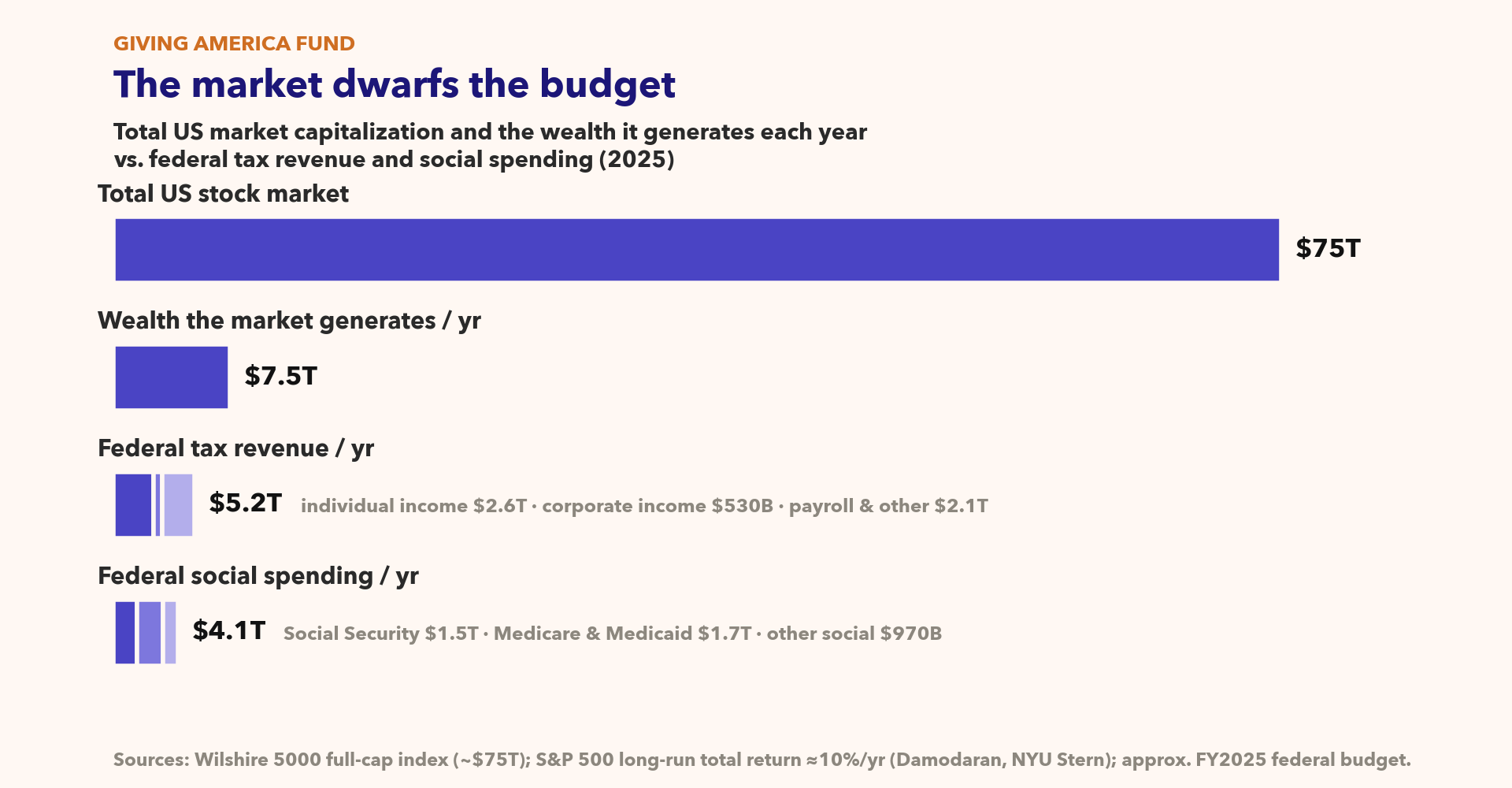
America’s greatest financial asset is not oil, but the American economy itself, which is so reliably generative that the entire world’s economic system rests on the US dollar.
And yet, almost none of these market earnings make their way to improving the prosperity of ordinary Americans. This was true at the beginning of the modern stock market, and it has only become truer over time, as taxes on capital gains have been reduced and kept far below taxes on wages and wealth has been allowed to pool at the top. The theory that keeping wealth in the hands of the wealthiest class somehow helps lower classes (“trickle down economics”) has been widely discredited. The economy has never been better for the rich, and yet the rest of America struggles to afford the skyrocketing prices of housing, groceries, and gas.
The Giving America Fund is an elegant solution to this problem, and the Fed is uniquely positioned to run it. As a sheltered, independent agency with a broad mission to promote a stable and healthy economy, the Fed can and should invest in the American stock market alongside these wealthy investors, and ensure that a portion of our national wealth makes it into programs that make Americans more prosperous — more happy, healthy, and socially and economically productive.
The Endowment (The Business Investment)
Let’s first discuss the Fund’s endowment. The Giving America Fund’s endowment would be primarily made up of two major assets:
A total US market investment fund
A minority ownership share of all G-Corps
I will only discuss the market investment fund in this article, as it has more predictable economics, and is thus simpler to model. G-Corps, which would be a more economically and socially effective alternative to 501(c)(3) nonprofits and B-Corps, will be described in the next article in the Giving America Series.
As noted above, the total stock market capitalization of public US companies is roughly $75 trillion. Of course, “public” companies is a bit of a misnomer, as the vast majority of this stock is owned by private investors. This is by design — private ownership is a core feature of the American economy. Private owners create a competitive market and shape the incentives which drive businesses in their relentless pursuit of profit. Of course, this orientation towards shareholder profit has many drawbacks, but it is also undeniably one of the primary reasons America is by far the wealthiest country in the world.
The Giving America Fund would capitalize on this profit orientation, not compromise it. It would involve no expropriation of private wealth, and would not be the nationalization of private industry. It would fit directly into our current economic structure by investing in American companies in the most boring and traditional way possible — by simply buying stock on the public market.
Specifically, the Fund would invest a sum equivalent to 1% of GDP every year (~$300 billion today, about 0.4% of the total market cap) in public US companies. This would be a broad-based, cap-weighted investment in the total US market, and would be regularly rebalanced like any modern index fund. And every year, the Fund would sell roughly 5% of its stock to fund its social programs.
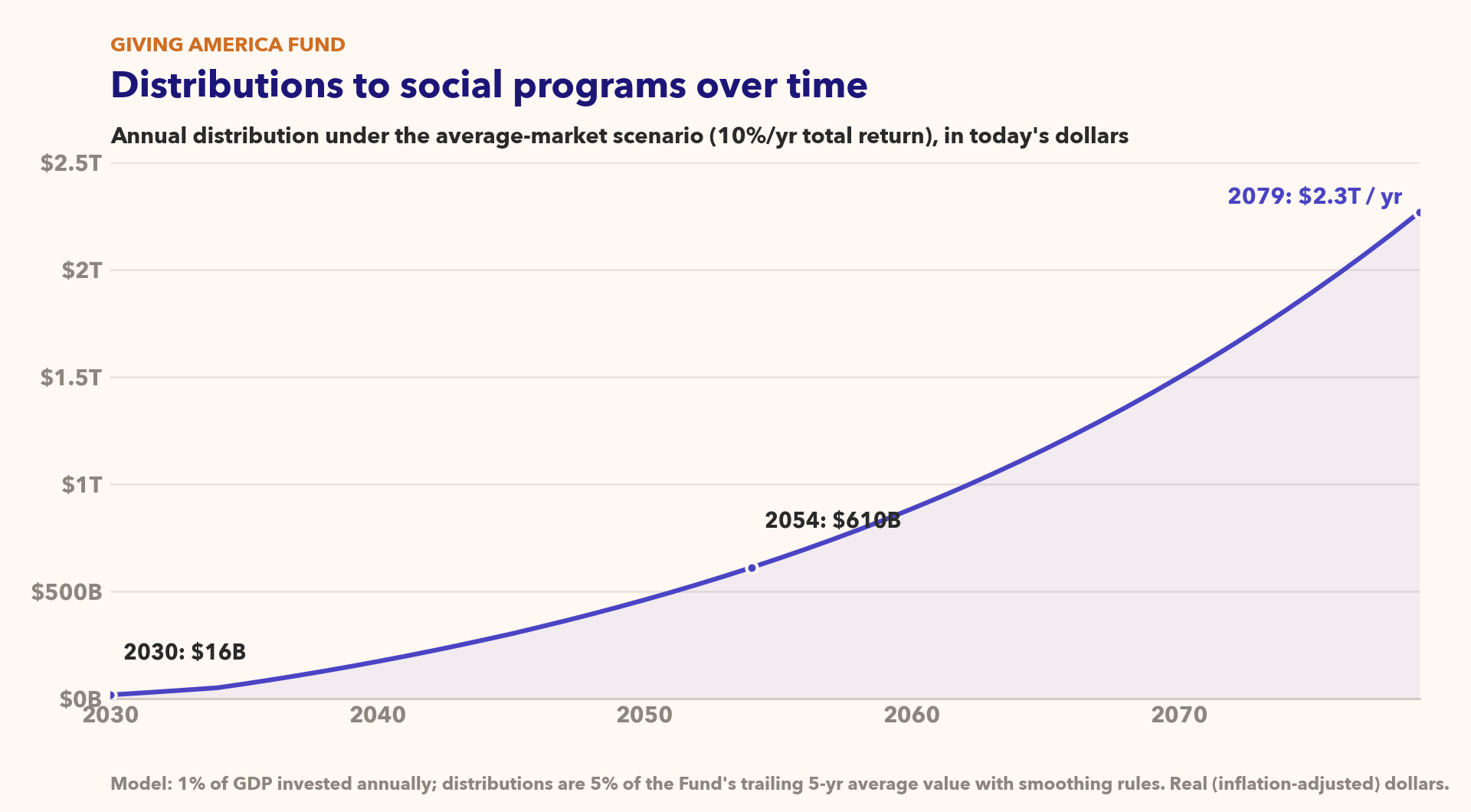
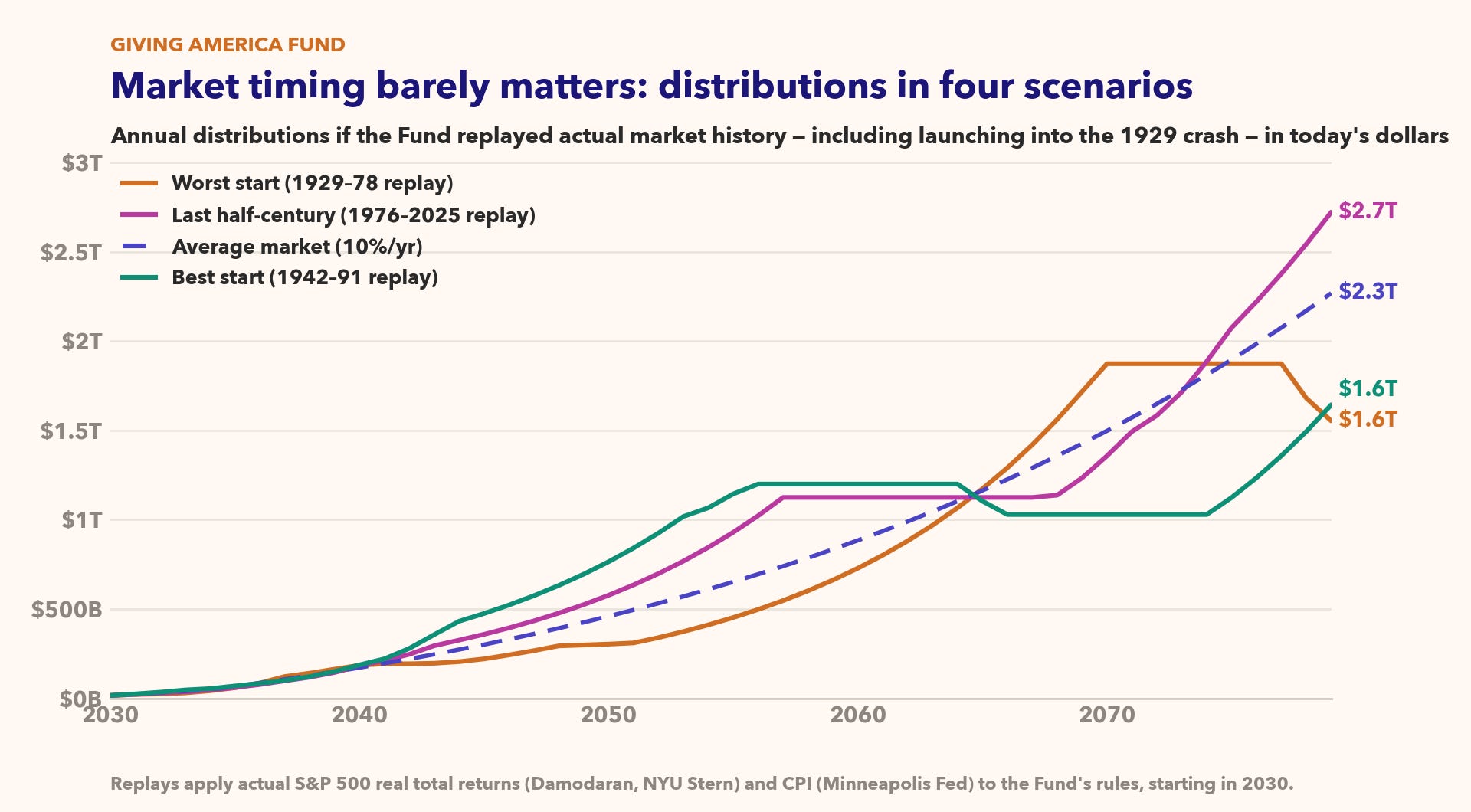
This would result in a yearly social distribution budget that starts small ($16 billion in the first year), but grows over time, reaching over half a trillion at year 25 and over $2 trillion at year 50. Below is a graph depicting a hypothetical “average growth” scenario. Keep in mind that timing the market doesn’t really matter here, as the very best and very worst case historical scenarios largely converge to the mean over time (see the “economic downturn” Q&A item below). This is because, unlike with other federal government concerns like Social Security or the National Debt, the unyielding math of cumulative returns actually works in the Fund’s favor.
I’ll describe what this budget will be spent on soon, but first, I’ll describe the fund’s investment philosophy.
Investment Philosophy
The Fund’s investment philosophy would be staunchly apolitical to avoid any risk of corruption. This is why it would be housed in the Federal Reserve, the only federal institution currently sheltered from presidential overreach, with its portfolio walled off from monetary-policy operations (just as Norway separates its fund from its central bank’s reserves). And this is why its investments would be total market investments — it would not be in the business of picking winners and losers.
The Fund’s ownership share of any individual company would start very small. In the first year, it would buy roughly 0.4% of the shares of every public US company. It would come as a small boon to American businesses, but it would not, at first, have any impact on their operations.
But over time, with repeated yearly investment, the Giving America Fund would begin to grow its ownership share. Within 15 years, depending on market outcomes, the Fund would grow to own roughly a 3-10% share of every public US company (with a legally-imposed cap of 10%). This would make it one of the largest shareholders in every public company in America.
This means that, while it would never come near to majority stakeholder status, the Fund would begin to exert a noticeable, growing pressure on the companies it is invested in. This is by design as well. Every investor implicitly shapes the priorities of the businesses it invests in. The much-discussed corporate “profit motive” exists because every company’s leadership has a fiduciary duty to be a faithful steward on the behalf of its owners. But many owners have priorities other than profit. If a meaningful portion of the company’s ownership has an unambiguous social purpose, the profit motive remains, but it sits alongside that social objective.
As a government institution and a voting shareholder, the Giving America Fund would be in a unique position to encourage (but not force) companies to act in ways that are good for the American people. It would not have majority power over any business, but it would be legally bound to vote according to its guiding principles. Those principles would be determined by the legislature, but I suggest that they should be the following: 1) to generate profit to grow the Fund and 2) to follow the four contributist principles — in sum, to expand and protect the right to give.
In other words, the Giving America Fund would give the American people a meaningful voice in American corporate governance. It would grow, over time, into a powerful activist investor on the behalf of the American people, shifting the basic priorities of every American business. It would also lend the weight of its voting power to other investors who want to press company leaders to act with more social responsibility.
The Distribution (The Social Investment)
A core defining feature of the Giving America Fund is that it is an investment on both sides — the money that goes into businesses is a direct investment from the US Treasury into the American economy, and the profit that comes out of the investments and is funneled into Giving America’s social programs is also an investment into the American economy, though this side is an investment into America’s human capital rather than its purely economic capital.
To ensure that this remains true, every social program funded by the Giving America Fund would have to, by design, be dedicated to increasing the capacity of Americans to participate in the productive effort of making our communities thrive. That is, increasing Americans’ capacity to give, in their own way, to the shared goal of making America a wonderful place to live.
There is no limit to what sorts of programs can be designed and funded, but to start, this distribution would be used as a funding source to make possible a series of programs which will be described in later proposals in this series. These include:
Education
Community college for all
Vocational training (through business partnerships)
Replacing student loans with Giving Fund income-share program
Family
Basic income for new parents and caregivers
Free child care through Pre-K
Health
Universal healthcare
“Drug bounty” pharmaceutical program and investment in generics
And more!
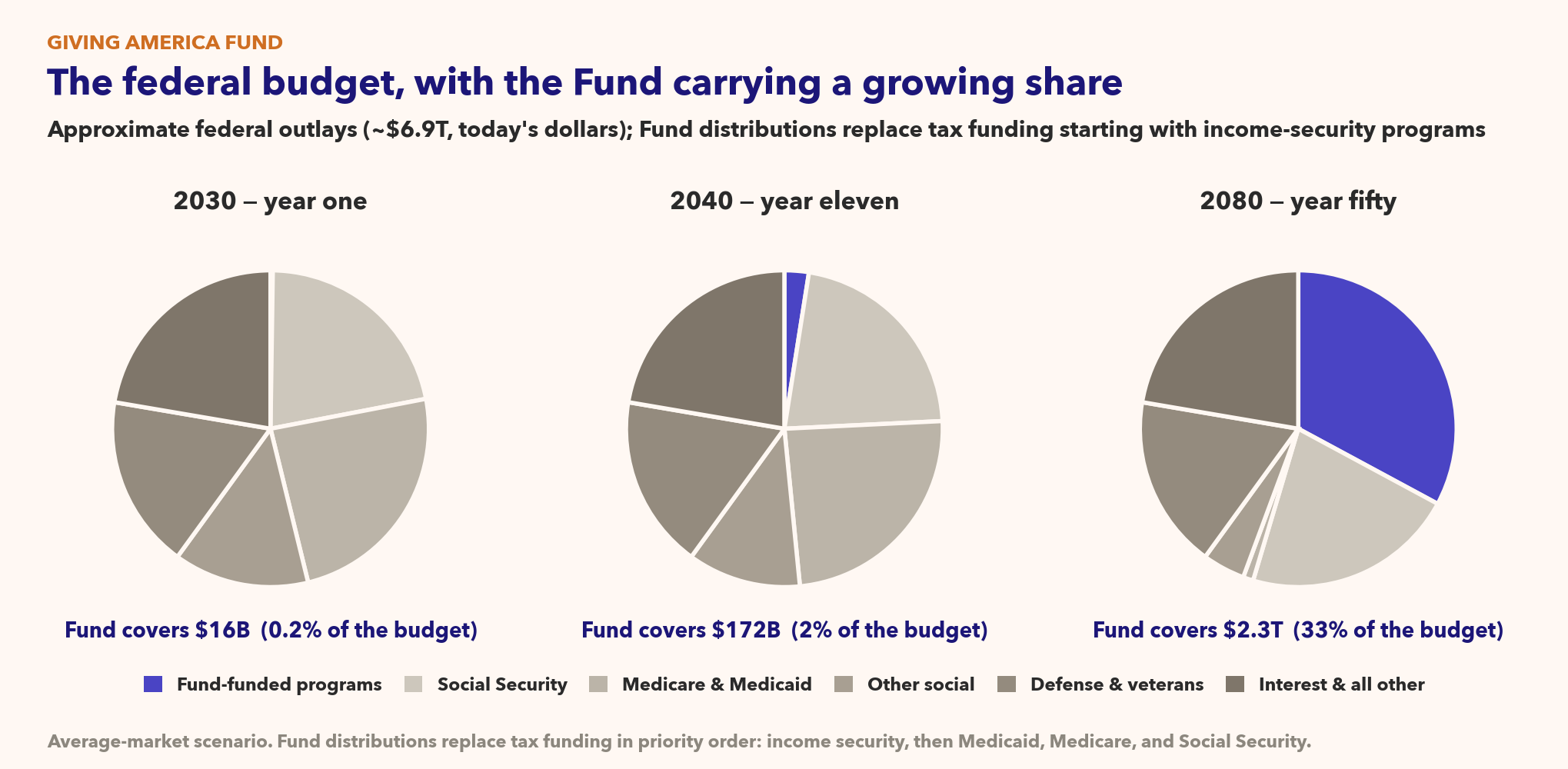
Additionally, as it grows, the distribution would become a replacement source for much of our current tax-funded social spending, meaning that we could actually reduce taxes over time because of the Fund. This would begin with smaller income security programs like WIC and SNAP, saving taxpayer dollars while accomplishing the Fund’s mission.
But its potential would grow over time. With time, it could fill the Social Security funding gap. It could lead to not only a balanced budget, but a surplus. And ultimately, powered by the diligence and determination of American industry, the Giving America Fund could bring into reach the sort of programs that are currently seen as economically infeasible — including a truly contributist take on a Universal Basic Income (proposal coming soon!).
Q&A
How can we afford ~$300 billion in extra spending per year?
It’s helpful to compare this to the $5.2 trillion COVID stimulus response of 2020-21 or the $800 billion bailout of 2008, both of which were funded by adding to the Treasury’s debt, rather than levying new taxes.
The Giving America Fund is significantly more fiscally responsible in two major ways. First and most crucially, this time the borrowing buys an appreciating asset instead of vanishing. This is a government investment, not government spending, and as an investment, it is as robust as the US economy. The stimulus and bailout were backed by vague promises of economic stimulation; the investment in the Giving America Fund would be backed by the growing coffers of the Fund itself.
Second, the investment would over time grow large enough to pay for social programs that are currently funded by taxes, reducing the spending deficit. Over a long enough time horizon (roughly 30-40 years), the Fund would ultimately save the US government more money than is invested into it. And even at its most expensive moment, the Fund’s entire twenty-year cash commitment would still be smaller than what we spent responding to COVID in twenty-four months.
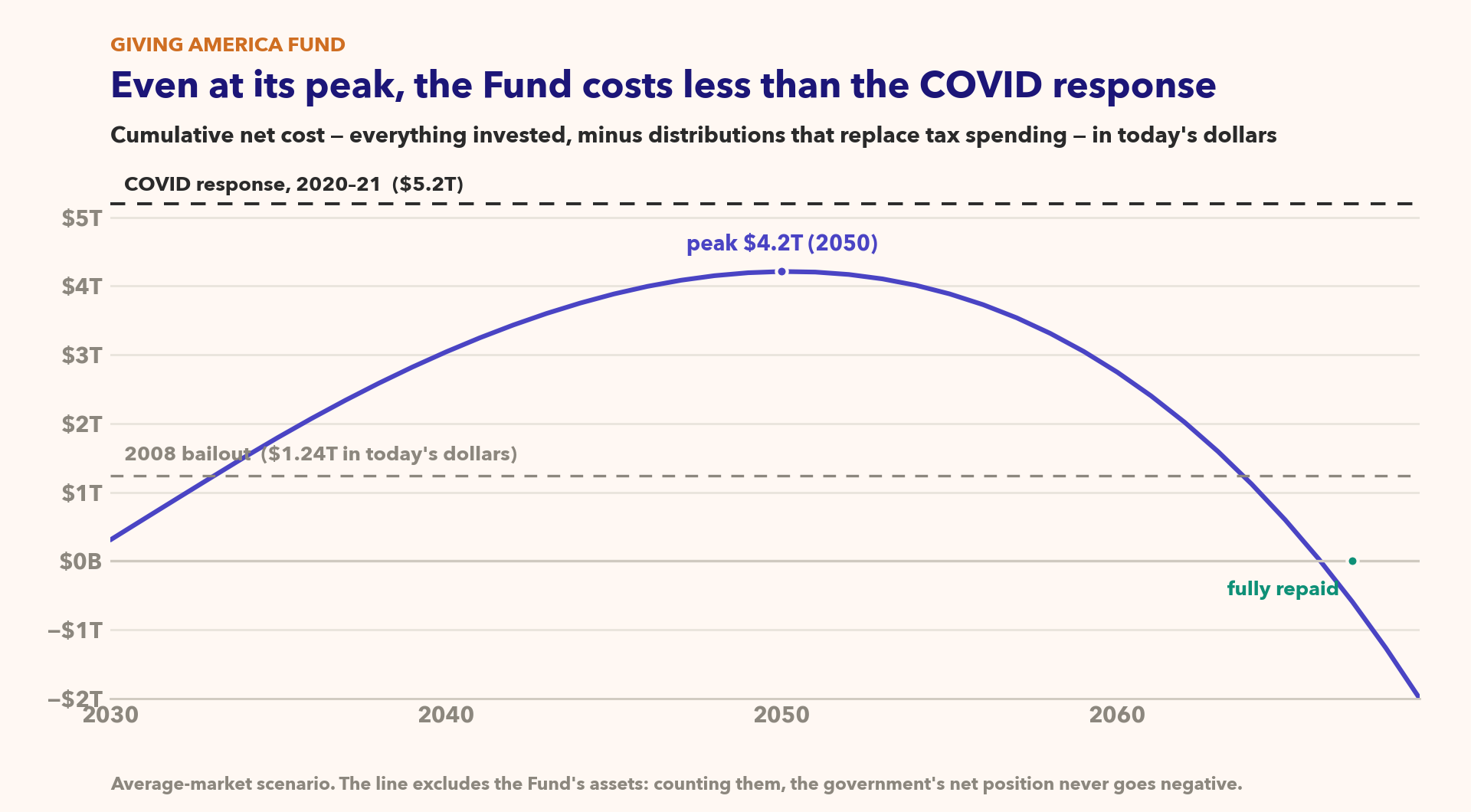
The key thing to remember is that the money that goes into the Fund every year isn’t spending; it’s investing. Asking how we can afford it is a bit like asking someone how they can afford to take $300 out of their bank and put it into an index fund. The money isn’t spent until it is disbursed from the Fund, so the most that will be spent in a year is not the invested 1% of GDP; it’s the sold off ~5% of the cumulative value of the Fund. And in almost every possible scenario, that 5% will just be the earnings of the investment itself.
The Giving America Fund is not new government spending; it’s a new government funding source, redirecting investor wealth into productivity-enhancing social programs.
Does this plan require us to tax a lot of wealth from the rich?
Surprisingly, no. It is true that the long-term consequence of the Giving America Fund would be that wealthy private investors would own a meaningfully smaller share of America’s wealth. But the Giving America Fund doesn’t require any new taxes.
Of course, the yearly investment could come from a wealth tax. But I suspect it would be both more politically viable and economically robust to just source the money straight from the Treasury.
What happens to the Fund if there’s an economic downturn? What happens to the programs it supports?
The 5% yearly distribution I described above is an over-simplification. The real calculation would approximate 5%, but would be a bit more complex, and include a number of built-in supports for this type of scenario:
First, the Fund would use a rolling-average of 5% of its value over the past five years (this follows the Alaska fund’s model), which dramatically reduces volatility and allows the Fund to essentially smooth out all but the longest-term downturns.
Second, after 15 years (to allow for maturity), distributions will be capped at a YoY increase of 10%, allowing excess gains to essentially form a reserve for downturns.
Third, In the event of a market downturn, the Fund will increase its distribution to up to 7% to smooth the downturn even further.
Finally, and counterintuitively, short-term economic downturns are actually good for the Fund, because they allow it to essentially “buy the dip,” and secure larger gains for the long term.
This is simply a proposal, so the details may change, but rules like these would ensure that Fund returns remain relatively stable in even the worst market conditions.
Could the Giving America Fund really support a Universal Basic Income?
Maybe! We'll discuss a contributist version of a UBI in a future article. An Andrew-Yang-style universal basic income of $1000/month for every adult would cost about $3 trillion per year in today’s dollars. Depending on market performance, the Giving America Fund could reach that amount (inflation-adjusted) on its own in 50 years, so it’s possible that we could fund a UBI this century.
Even more encouraging is the fact that the UBI wouldn’t have to be funded on the Fund’s market returns alone. G Corps (described in a later article) will also provide revenue that the Fund can allocate. And if the Fund’s social programs replaces the need for some existing taxpayer-funded social services, we could instead funnel that tax money into the UBI, increasing the available budget by another $1-2 trillion.
As Keynes said, “Anything we can actually do, we can afford.” The problem isn’t that it can’t be done; it’s simply that we don’t realize we can afford it. We have a $75 trillion economic engine, but it is near-totally disconnected from our collective national budget. The point of the Giving America Fund is to tie our incredible economic means to our lofty economic goals. When that’s done, there will be almost nothing we can’t afford.
Government ownership of companies? Isn’t that communism?
No, this isn’t communism. It is simply a way for the American people to get a share of the wealth generated by American industry without having to be wealthy investors themselves. Currently, market prosperity isn’t tied to national prosperity — it only makes sense to ensure that all boats really do rise with the market’s lifting tides.
Importantly, the government wouldn't “own” companies in the traditional sense, because it is not taking anything close to a majority ownership stake (the legal maximum would be 10%). Companies are not compelled to do anything the Fund wants. In fact, the Giving America Fund is actually a bit weaker than the average investor would be with the same ownership stake, because it doesn’t even have the ability to opt out of investing. And to the extent that the Giving America Fund has influence through its voting power, it is legally bound to operate only according to its democratically-determined principles.
And if you are still worried about the Fund’s influence, consider this: an interesting function of the investment model (1% of GDP yearly, with a 5% sell off yearly) is that the fund actually shrinks as a share of the market when the US market is doing well, and grows its share when the market is doing poorly. In our historical modeling, the fund hovers at around 3% in strong markets, and only approaches the 10% cap in periods of protracted recession or stagflation.
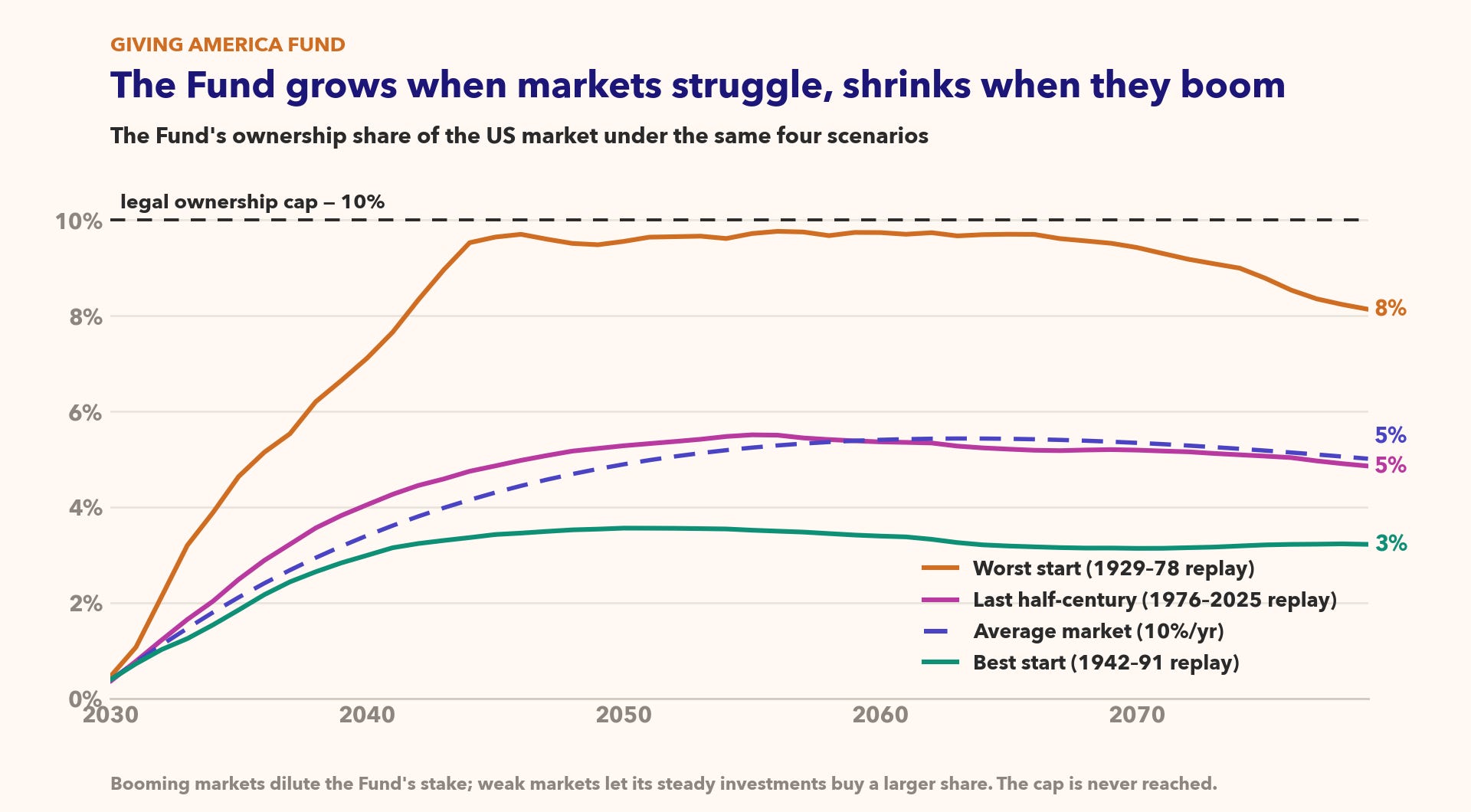
That means that the Fund’s influence is an ideal governance mechanism — it kicks in when “unfettered” capitalism is failing, and retreats when markets are doing well.
And remember, the Giving America Fund is on the companies’ side — its goal is to ensure American markets are profitable, because for the first time in the history of American markets, it would ensure that when the companies win, so do we.
Thoughts on this proposal? Leave a comment below!
This proposal is part of the weekly Giving America Series. Model it on the roadmap alongside all the other proposals at contributism.org/giving-america.