

This proposal is part of the weekly Giving America Series. Model it on the roadmap alongside all the other proposals at contributism.org/giving-america.
“I am a cell-sized unit of the human organism, and I have to use my life to leverage a shift in the system by how I am, as much as with the things I do. This means actually being in my life, and it means bringing my values into my daily decision making. Each day should be lived on purpose.” - adrienne marie brown
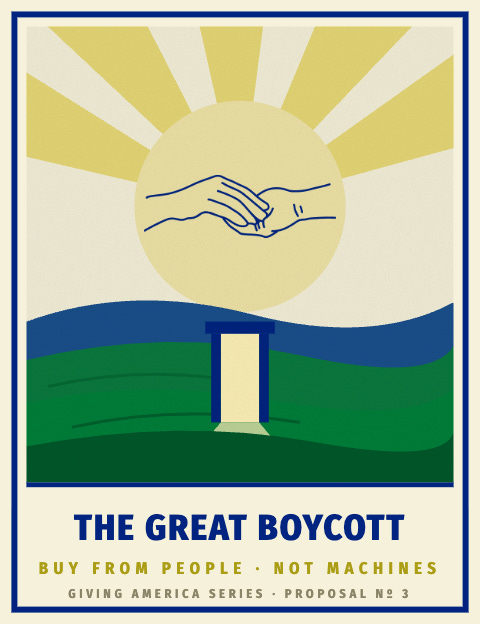
The Great Boycott
I commit to avoid buying anything without at least one human interaction.
Do our individual actions change the world, or does real change only happen when political leaders make large-scale policy decisions?
In this brief article, I’m going to suggest a boycott that’s simpler than it sounds, but more radical than the ones you’re probably used to. It will also be arguably much more effective, both in improving your own life and in fighting the systemic problems that may have led you to other boycotts in the past.
But first, the agency question — can individual action change a broken world? This is a debate as old as society itself, and I’m sure you have a position on it, as do I. But I’m not going to answer the question. Instead, I want to challenge a couple of assumptions that are baked into it.
First, the question assumes that there is only one world to change. But there are many. Each of us inhabits our own position in the world, and from that position, we live a wholly unique life. Some of us live in a world where the air has always been clean; others live in areas where the air is very dirty. For some of us, strangers can generally be trusted; for others, strangers are hostile. For some, there is always enough food to go around (and if there isn’t enough, we can buy more); others know what it means to truly go hungry.
The point is, different corners of the world are meaningfully different. This means that change can happen in your corner of the world, even if it lags in other corners. So while it is true that your individual actions will probably not change the whole of America, you can radically transform the world that you inhabit — and improve life for you and your community.
The second assumption in the question is a false dichotomy. Individual action and large-scale policy are not alternatives. They go hand-in-hand — they work together to create change. Policy doesn’t come from nowhere — policymakers are always taking in information about the ways people act, and they use that as a signal for where “the people” are and where they need to go. When you begin to act differently as an individual, you are making a statement, and people are listening. The more visible the individual action, the more likely it is to shift policy.
Finally, I think the question is usually asked in bad faith. I don’t mean intentional bad faith, but something more unconscious and self-sabotaging. As I wrote in the Giving America Manifesto, cynicism is an immune response that we develop over time, as a protective measure against false hope. I think it is our cynicism that tells us that our actions have no value, that we should not act at all; because when we do act boldly, we let hope start to sneak in through the cracks.
Our actions do matter. They are the impetus for policy change, and even when they don’t change the world, they do change our world and that of those around us. And they are a rebuke to our pessimism — they remind us that our own lives can in fact be different, and in these differences, we remember that joy can come from unexpected places.
Proposal: The Great Boycott
The Great Boycott is as simple as the tagline to this article: buy from people, not machines. More specifically, it is a simple commitment not to buy anything without at least one human interaction. You can choose the boycott in one of two flavors:
The Soft Boycott
I commit to avoid buying anything without at least one direct human interaction.
The Hard Boycott
I commit to avoid buying anything without at least one in-person human interaction.
The difference between the two isn’t about your level of commitment, but the specific type of change you want to achieve in your world. I’ll explain more in the Q&A, but first, I want to explain why I’ve been adhering to The Great Boycott and why you should consider it too. There are a number of reasons for the Boycott, and it comes with a number of benefits.
First, machine transactions are fundamentally alienating. Yes, buying a shirt on Amazon is convenient and gives us a rush of dopamine, but it comes with a cost. It seems like every study in recent years shows that we are all living increasingly lonely, isolated, and anxious lives. Remote work has come with significant benefits, but it has also led to less time spent with friends, more mental distress, and greater use of antidepressants. I recently learned that the average person spoke 28% fewer words per day in 2019 than in 2005. And that was before the pandemic!
When we speak about the loneliness crisis, we tend to focus on the importance of deep friendships and romantic relationships. We give considerably less focus to the loss of weak ties — the small interactions with neighbors, coworkers, baristas, clerks, receptionists, and so on, which used to characterize day-to-day life, but are also steadily decreasing. These interactions may feel meaningless, even annoying at times, but they boost our mental health by making us feel connected to a larger community. Returning to buying from people is a small turn back towards human interaction, but it can have an important effect on our sense of connectedness to others.
Second, machine transactions support the oligarchs. Take a moment to look at this visualization of Jeff Bezos’s wealth; it’s the best one I’ve seen and it’s worth a quick scroll. Today, Bezos has about twice as much wealth as he did when that visualization was created. Have you ever wondered how he got so rich? We all know how — he got much of that wealth by taking a portion of every dollar you spend on Amazon.
Of course, not every dollar you spend online is spent at Amazon. But today, at this point in late-late-late-stage capitalism, we can no longer afford to play dumb about where our money goes. Fundamentally, the more abstract and depersonalized your transaction is, the larger the share of it that ultimately goes directly into the hands of oligarchs. The Great Boycott is a dead-simple heuristic that cuts directly to this truth. If you commit to the Boycott, you no longer need to spend your time trying to determine if this or that shadowy online company is signaling the proper virtues. You can be sure, at least and at last, of one thing: that you are doing a good thing for the person on the other end of the transaction.
Third, human transactions support humans. The structure of the Great Boycott guarantees that the person on the other end of the transaction is a relatively normal human like you. That’s because you won’t have a direct interaction with Jeff Bezos. Of course, it does not guarantee that all of your money is going to that human. But some of it is, and that’s more important than it seems. A company that allows purchases through human interaction is a company that retains a heavy reliance on human labor, and is not abstracting its jobs away to consolidate profits. This is especially important as AI job displacement ramps up; the Great Boycott ensures that you are supporting real jobs for real humans. Plus, even the smallest direct interaction allows you to learn something about the company’s vibes — do its workers seem contented or exploited? Are they well-paid? (You can even ask!) The Great Boycott ensures you’re taking the right first step, and you can make further decisions from there.
Fourth, human transactions support communities. Perhaps the most important economic impact of the Great Boycott is that you are choosing which communities your dollar supports. This is especially true if you’re doing the hard boycott (in-person interactions), because it means that, by definition, every transaction is helping someone in your physical vicinity — your lived community. Again, The Great Boycott isn’t perfect — if you’re shopping at Walmart, you’re still supporting the Walton family’s $500 billion fortune. But it’s unambiguously taking a step in the right direction — at least you are supporting local workers, who also need to eat. (And since you’re out anyway, why not pick up what you’re looking for from a locally-owned grocery or clothing store instead?)
Fifth, human transactions provide you with the right to give. This is best explained in the most popular article on the Contributist Reader: “What is the Right to Give?”. Contributists argue that the act of giving is the humanizing act. Of course, not every human transaction is an act of giving, but it can be. In a machine transaction, on the other hand, the transaction is facilitated end-to-end by automated processes, so there is no opportunity for us to give at all. The transaction is guaranteed to be an act of empty, lifeless consumerism. The Great Boycott is, above all, a rejection of lifeless consumerism and a commitment to re-assert your own humanity, to become a person who lives, and whose life is characterized by giving.
There is much more that could be said, but I think, in this period of late-late-late capitalism, this proposal mostly speaks for itself. As I said, I have been adhering to The Great Boycott, and it has been a challenge in some ways, but an ultimately engaging one, which I intend to continue indefinitely — I’ll post an update on my experience in the near future.
My challenge to you is to commit to trying The Great Boycott yourself for just one week to see if you like it. See what it would require of you, and how it would change you. See if it gives you a bit of joy and a bit of hope.
And if you’re still hesitant, you can visualize exactly what the Great Boycott would look like for you and your household on the Giving America website.
“Your no makes the way for your yes. Boundaries create the container within which your yes is authentic. Being able to say no makes yes a choice.”
- adrienne marie brown
Q&A
What’s the difference between the soft boycott and the hard boycott?
The soft boycott allows “machine purchases” as long as there is a direct human interaction involved at some point. This could be a simple chat, email, or phone call. Uber Eats counts if you text your driver “Thanks!” Etsy or Ebay also count if you chat with the seller directly.
The hard boycott requires that there is an in-person interaction involved. This means that Uber Eats only counts if you actually meet the driver at the door. Etsy and Ebay are probably off-limits as well.
The soft boycott is for those who see their community in broad terms, or for those who simply want to take steps to stop supporting oligarchs. The hard boycott is for those who want their dollars to support the economic growth and development of those in their local community, or those who want to push themselves to engage more deeply with their community in its physical spaces.
Can I pay for online subscriptions like Spotify? What about HelloFresh or Book of the Month?
The simplest distinction is that you can buy online things online, but any physical things should be bought in-person. So Spotify is okay, as is your favorite creator’s Patreon. Book of the Month is a very cool program, but I would argue that it’s even cooler to go to your local (almost certainly struggling) bookstore once a month and see what they’re recommending — they always are, and the recommendations will be more personal and passionate than anything you’ll get from an online service.
What if I do it but have a cheat day, or a cheat purchase area?
Nobody’s forcing you to do this! I strongly recommend making the commitment fully, embracing the discomfort, and exploring where that discomfort leads you. The discomfort is what forces you to give more of yourself, to interact more with others, to better your mental health by building more weak ties, and maybe even discovering some strong ones. It’s the discomfort that shakes you out of your status quo and forces you to find yourself in unexpected places. But again, nobody is forcing you. Try it for a week and see what you think. And if you need a cheat day, take a cheat day — I won’t tell!