

The American Dream of the 20th century rested upon the ideal of home ownership. Each American aspired towards having their own miniature fiefdom: a grand castle (a single-family house), surrounded by beautiful rolling fields (a lawn), and fortified by a magnificent wall (a white picket fence). More profoundly, we wanted to have the space, the privacy, the freedom to be truly autonomous. This desire itself is not novel or intrinsically unethical. When we look to grand palaces, both ancient and modern, it is apparent that this desire has persisted across many cultures regardless of technological advancement or contemporary taste.
But even innocent desires can lead to harmful developments. The desires which led us to develop ultraprocessed foods and social media were not intrinsically immoral, but we now understand how both have had clear and measurably negative impacts to our societal health and well-being. This same evolution from innocence to injurious is also present in the physical segregation of our housing infrastructure, which has fractured our communities.
Today, “Housing Affordability” is arguably the most pernicious political football in Western politics. Across both sides of the aisle, politicians recognize the gravity of the issue, and while solutions are slowly becoming law, we need to think further than simply increasing access to the housing market. We have to address the inherent flaws built into the system of housing and transportation that has defined America for the better part of the last 70 years.
As part of our Giving America series, we want to propose a holistic re-imagining of what cities should aspire to be in modern America. To learn from the hard-won lessons of the 19th and 20th centuries, and let those insights lead us into the 21st.
1D, 2D, and 3D Cities
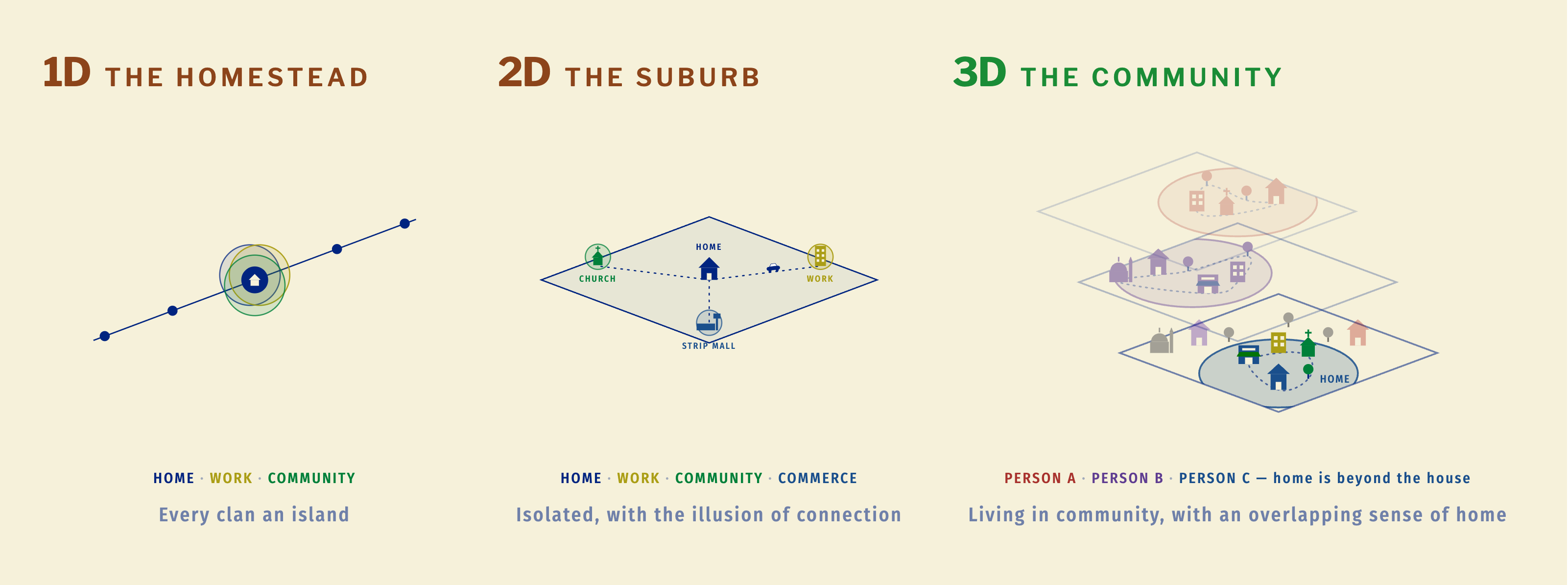
One way to think of the history of the American dwelling is in terms of physical and social dimensions.
The first manifestation of the American dream was life as a pioneer. It was manifest destiny; it was the little house on the prairie. Of course, there were many types of 19th century American lives; not everyone got to live out the dream. But the dream stood tall in the American imagination. The pioneering family was strong and brave, independent and self-sufficient. They were all-in-one; home, work, and community all unto themselves. In other words, we first believed that the ideal American lifestyle was one-dimensional — every clan an island, a disconnected point on a line, an isolated unit.
By the early 20th century, the West had mostly been discovered, and the car and the industrial revolution had reshaped the economic landscape. The pioneer lifestyle, with limited electricity, limited community, and no access to exciting new technologies like movies and landline telephones, was looking less and less idyllic. We realized that it was not so good for man to be alone.
It was in this context that the second manifestation of the American dream emerged: the suburbanite. It was the nuclear family; it was Chic Young’s Blondie and Dagwood Bumstead; it was the cookie-cutter miniature fiefdom. Of course, in postwar America, there were many types of American lives; but none so aspirationally, so essentially American as the suburban family. The suburban family was happy and dignified, worldly even. They traveled on road trips, and brought home impressive souvenirs. They barbecued.
This second vision of the ideal American lifestyle was two-dimensional. It was not as isolated as the pioneer vision, but it was still far more constrained than we could have understood at the time. Life became one big hub-and-spoke — you hopped in your car and traveled to work and back home, to the strip mall and back home, to the church and back home. You developed a compartmentalized life — home, work, community, and commerce were four disconnected spaces; four disconnected selves. And the mediator between them was the dreaded commute. Spontaneous interactions dissipated, as the world was theoretically accessible from home, but in reality, far away from it. You believed yourself to live in community, but you didn’t really — you lived in your house; community was a place you visited.
But if the 19th century ideal was proven to be one-dimensional, and the 20th century ideal was proven to be two-dimensional, perhaps we are finally on the cusp of a better vision of the American lifestyle — of truly three-dimensional living. What would that look like?
There is a lot of talk about walkable cities these days, or European-style density, or even communes, as we grasp for what we now see was missing from the suburbs all along. I think in all of these we are grasping in the same direction — for the new, three-dimensional American ideal. We don’t want to be alone, but we also don’t want our lives to be fully compartmentalized and mediated by commutes. We want to escape from our isolation, and to live in true community.
The Proposal: Live in 3D Cities
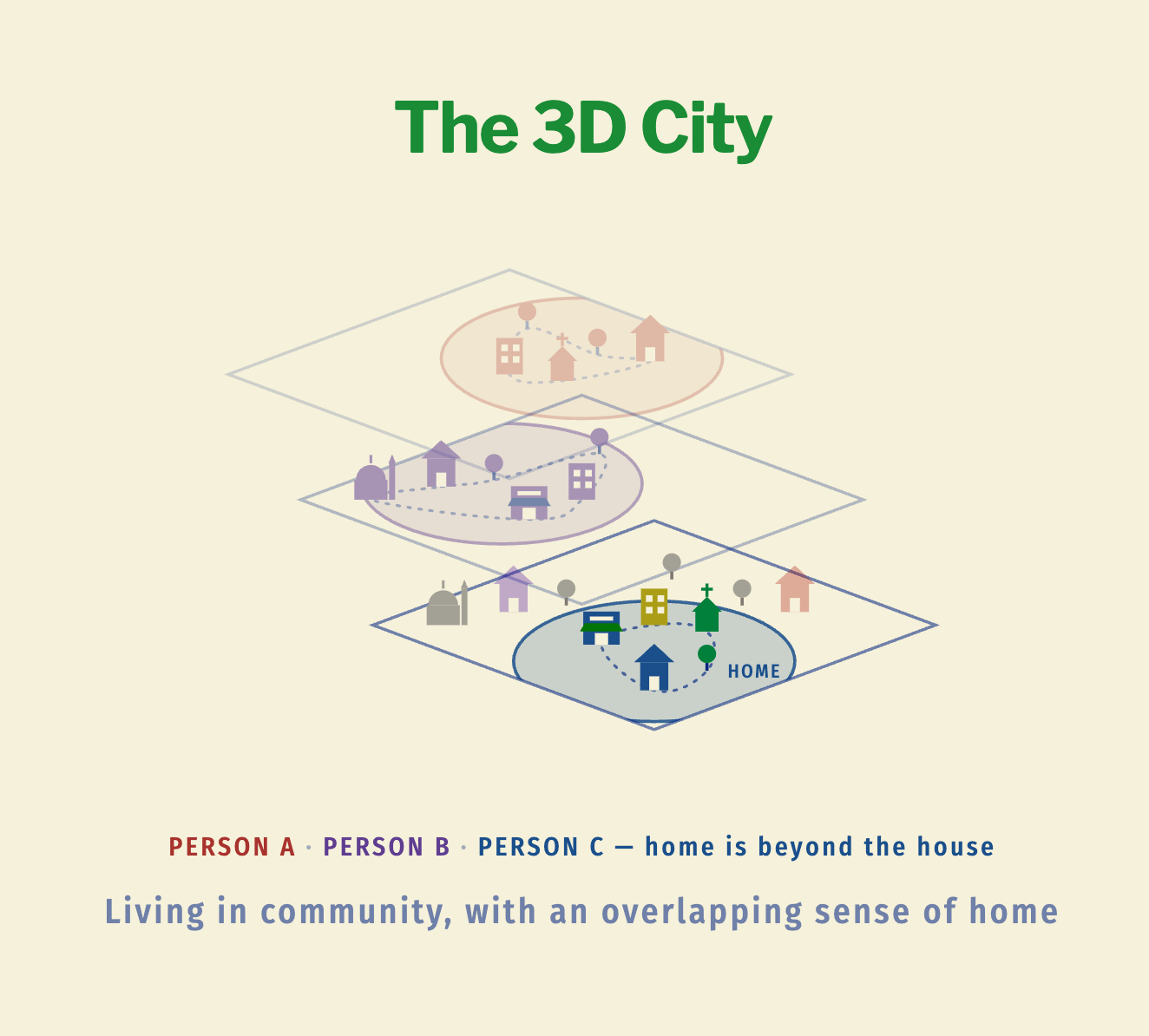
The graphic above depicts what we believe a 3D city looks like. It is a place in which you feel the safety and comfort of home not just in your house, but in a much wider space, in which you engage with a real community. In a 3D city, no two individuals have the exact same home boundaries, but there is great social overlap, which is what makes the community both familiar and diverse — a space where true connection happens.
We have come to call this type of community a 3D city, because we would ideally see these communities planned at the city scale. But they can come in all shapes and sizes. Already, there are many places in the US that could be called 3D micro-cities — we’ve seen them in co-housing spaces in Oakland, in mixed-use neighborhoods like Mueller in Austin, and on nearly every residential college campus in the country (where home, work, and community sit within a ten-minute walk and many people look back fondly on their time there as the best years of their lives).
Because the 3D city is an expansive concept, the best way to describe a 3D city is to explain the ways in which it differs from a 2D city.
The 2D City is Sparse ➔ The 3D City is Dense
Much has been said about the sprawl and artificial sparsity of the American city, far more eloquently and convincingly than can be done here. Experiments like Culdesac in Tempe, Arizona, and the Old World charm of older urban fabrics in cities like Charleston and Savannah still retain much of the walkable city design that was necessary in an era before the car. Still, the fact remains that the centers of commerce and creation are much more modern, car-centric cities; megalopolises like Los Angeles, Atlanta, and Chicagoland. The artificial sparsity within these centers of commerce, largely entrenched through zoning laws, is an outmoded characteristic that needs to change. This sparsity erects immense barriers, both literal and figurative, to building and maintaining community, and the cost to maintain the infrastructure to deliver modern necessities like water, sewage, power, and garbage collection is a burden borne by all residents, disproportionately impacting the most economically disadvantaged.
The 3D city challenges the idea that the average American needs nearly double the square footage of our neighbors across the pond. Residents of 3D cities tend to spend much of their leisure time outside of their homes. Smaller home sizes tend to encourage this sort of lifestyle, while McMansions tend to encourage isolation.
While median home sizes in America are shrinking, there is still a dearth of variety in the homes we build. Summer 2025 saw a sharp drop in the number of multifamily housing starts while single family homes continued to grow. Overall, though, it is positive to see growing recognition of the “missing middle” — a category of housing that spans everything between single family homes and mid-rise apartments — and the benefits this density can bring to affordability, sustainability, and community.
The 2D City is Captive ➔ The 3D City is Expansive
London, Paris, Berlin, Rome, Barcelona all offer something that most American metros do not. Any tourist can fly in, rent a hotel room, and immerse themselves in the city. In America, only NYC comes close to offering that same experience. Nearly everywhere else, you’d need to spend hundreds of dollars on a rental car or Ubers just to get around; it’s practically an entry fee for the American city. This is the captive nature of American cities — and it makes movement in and between cities incredibly difficult, as recent tourists were made acutely aware during the 2026 World Cup.
But American cities also feel captive for another reason — economics. As the cost of living continues to rise on the back of rapid inflation, the choice of where to live keeps growing more difficult and fraught. Does a couple looking to commit to a 30-year mortgage and start a family aim to live near their parents, or where they can find stable, gainful employment? And as the Internet Revolution has concentrated financial flows into a handful of cities, more and more workers are facing the reality that professional development may come at the expense of personal fulfillment.
The 3D city is a place that solves both of these problems. Its community-centric design gives you more freedom to live wherever you want to live, not less. Imagine a future America in which you could fly into any of the top 50 metro areas and immediately embed yourself in the community, without needing a car, a pre-existing connection, or a plan. 3D cities are places where this is possible, because opportunity operates at a hyperlocal scale — home, work, and community are all interconnected. If America had more 3D cities, Americans would feel less stuck; they could pick a place on the map and build a rich, meaningful life there, rather than going wherever the markets force them to go.
The 2D City is Homogeneous ➔ The 3D City is Diverse
American Suburbia is banal and uniform. There is a tried and true formula to how sub-divisions are laid out, with the same two dozen fast food brands lining every stroad and strip-mall (albeit with some small regional variety). Traveling through the townships of Michigan feels no different than the beltway cities of Houston. Whether the nearest supermarket is a Meijer or an HEB is of little consequence. I get into my car, I drive 10-15 minutes, I load up with the groceries I need, and I might run a few other errands on the way home if convenient. This exact same narrative plays out every weekend, for tens of millions of Americans, all across the lower 48. There are some unique cities in America (New Orleans, Santa Fe, and Portland come to mind), but they are the exception that proves the rule.
With their density, 3D cities bring a stronger and more varied economic base that can foster unique and renowned sub-cultures. The 626 area code of East Los Angeles has come to be synonymous with some of the best Chinese food in America. It is not a coincidence that this also happens to be where many Chinese, Taiwanese, and Cantonese immigrants settled in the ’70s and the ’80s, bringing their regional cuisines and tastes alongside an entrepreneurial spirit and a desire to build anew. This pattern of cultural import, assimilation, reproduction, and, lastly, recognition, is the true secret sauce of the original American Dream, and remains the most essential part of what America promises. From the southern Italian immigrants that made red sauce a staple in American pantries, to the wave of Yemeni coffee shops bringing Arabic coffee culture to the Bay Area, America’s unmatched strength lies in our ability to negotiate the balance between cherishing our differences, and still remain united.
The 2D City is Unfamiliar ➔ The 3D City is Familiar
The isolation caused by sparsity and car-centric transit means that Americans are increasingly disconnected socially. Couple this with the increasingly uncertain nature of careers due to rapid lurches in technology, and there are few incentives and many barriers to forming interpersonal connections in our physical proximity. Why chase the acceptance of a neighbor across the street when the parasocial adoration of a hundred thousand red hearts is a tap away? Why even learn your neighbor’s name when you might move to a new city next year?
Digital nomads represent the most extreme form of homogeneous unfamiliarity present in modernity. The varied destinations where they physically reside are merely backdrops for socials and Zoom work calls. Somehow their home base, the specialty coffee shop, replete with ceremonial grade matcha lattes and high protein smoothies, is a universal constant, no matter if the IP address is in CDMX, Seoul, or Bali.
3D cities naturally foment interaction, and diversity adds a little spice to help find commonality and solidarity. The challenge here is to move out of the digital space and back into the real. Escape the Matrix, and trade the parasocial for the real social. Jane Jacobs, in her seminal book on urbanism, “The Death and Life of Great American Cities”, describes the safety and security of dense urban spaces, with watchful eyes attached to empathetic and caring humans. 3D cities foster safety through close community. Flock cameras, CCTVs and data brokers find their value in the 2D city, where isolation has long since broken down our social trust. The difference between the 2D city and the 3D city is not whether or not you’re being watched. It’s that, in the 2D city, you never know who’s watching you. In the 3D city, you do: it’s your friends and your neighbors, watching your back.
The 2D City is Fragile ➔ The 3D City is Resilient
A topic far from the mainstream consciousness — likely driven in part by “the failure gap” — is the fragility of the infrastructure girding suburbia. In recent history, America has needed to weather grave failures in these systems, whether it was the deadly winter storm that hit Texas in 2021, or the multi-decade process to move away from lead pipes, most infamously brought to light through the Flint Water Crisis starting in 2014.
The problem is that the 2D city system itself is built on an unsustainable economic model. Charles Marohn, with his non-profit Strong Towns, argues that the greatest risk facing cities today is financial instability. Few cities are in a truly healthy fiscal position, with tax revenues that offset their enormous overhead, and fewer still are places that are attractive to would-be residents. While all cities must struggle to balance their budgets and maintain this infrastructure, suburbia exacerbates this challenge as sparse city design means greater costs to serve fewer people. In many cases, the American city has become too expensive to fix; too expensive to be made resilient.
Not only do the finances work out better for denser cities than sparse ones — familiar cities, where there is high intracommunity trust, are fundamentally more resilient. In the You 2.0: Fighting Despair episode of Hidden Brain, Dr. Jamil Zaki shares a tale of two Japanese neighborhoods in Kobe, Mano and Mikura. The tight knit, high trust community of Mano led to less short-term damage from the effects of the 1995 earthquake, due to a rapid response from the community. That’s the marker of a 3D city.
How to Make Your City 3D
There is no one way to build a 3D city. What makes a 3D city is entirely dependent on each community’s — and each individual’s — wants, needs, and aspirations. To build a 3D city requires exploration, trial, failure, and reflection. A community of like-minded individuals in their 20’s may grow apart in their 30’s, and that is normal and to be expected. The core tenets of what differentiates the 3D city from our current designs is that these are places where we, as residents of America, choose to come out into our city centers, to revel in the presence of humanity, and to commit to supporting our fellow human beings.
As an individual, taking up The Great Boycott is a concrete first step to start shifting your city in this direction. Choosing to only engage in commerce through in-person interactions is supporting jobs and people in our local space. It is choosing to eschew absolute optimization and ruthless efficiency to maintain our humanity.
Perhaps the most consequential step you can take towards living in a 3D city is just choosing to live in a place that already has some of the three-dimensional traits described above. If you’re in the market to buy, buy a townhome or a unit in a duplex. If you’re a renter, try to find a place with plentiful nearby community spaces, and then make use of those spaces. If you have some geographic flexibility, choose to live in places that actively zone for multi-family construction, rather than places that try to keep houses big and communities small.
Finally, as far as it’s possible, try to transition away from being car-centric. The less you drive, the more likely you are to build a strong community nearby. Plus, supporting public transit goes a long way towards helping communities stay 3D, because when public transit dies, the suburbs win; and when public transit expands, cities become more 3D.
Like the residents of Flatland, who found the concept of a third dimension incomprehensible and farcical, the modern American has been conditioned to believe that the best the world has to offer is a two-dimensional lifestyle. Our base set of requirements for “good” living include: a large, spacious and well kept home, served by wide, paved roads (kept in pristine condition by the City) leading towards glittering storefronts, with every product and service necessary to keep up appearances. And, of course, a personal car to go between them all. Free parking, ideally close to the entrance, is the cherry on top.
But we live in the 21st century — it is time that we recognize the shortcomings of last century’s ideal, and learn to see beyond it. It’s time we update our values and begin to seek three-dimensional lifestyles.
Housing affordability is a superficial symptom of a much deeper root cause. Last century’s American dream — the suburban lifestyle — could have only led where it did: to sprawl, exclusivity, ballooning costs, and isolation. If we choose to maintain the paradigm of the Suburban Experiment, we willfully ignore the financial, environmental, and interpersonal strain that our societies must bear to maintain an outmoded way of life. Instead, let’s choose to expand our homes beyond our walls, and our American dream into a whole new dimension: more resilient, familiar, and inspiring homes in 3D cities.