

This proposal is part of the weekly Giving America Series. Model it on the roadmap alongside all the other proposals at contributism.org/giving-america.

“For what shall it profit a man, if he shall gain the whole world, and lose his own soul?” — Jesus of Nazareth
When big businesses in America do bad things — when they make their products worse for consumers through shrinkflation or planned obsolescence; or when they get us hooked on ultra-processed foods or infinitely-scrolling outrage feeds; or when they underpay or overwork their employees; or when they pollute shared rivers, or cut down forests to build data centers for AI; and so on, etc. — they don’t do it because they hate us, or because it somehow excites them to see communities suffer.
They do these things because they are, ultimately, amoral beings. They are simply doing what their corporate structure requires them to do: increase profit for their shareholders.
The profit motive is an interesting thing. It is an emergent property of corporations, not something that is decided by any nefarious individual at the top, or even any set of individuals. In fact, the often-reviled CEO of a company is the biggest slave to the profit motive, not its master.
The CEO knows that if she fails to produce satisfactory quarterly growth numbers, she will be replaced with someone who will.
Replaced by whom? The board, who is initially determined by the corporate charter, then periodically voted into position by the shareholders, and whose primary job is to fire and replace the CEO if she does not act according to their will.
And who are the shareholders, and what is their will? Usually, nobody really knows. Or to be more precise, as a company grows, so do the ranks of its shareholders and their interests become quite diffuse. The shares of large private companies are usually bought up by hundreds of private investment firms, each of which must act as a fiduciary on behalf of its own diffuse set of funders. For a public company, the roster is even more byzantine — if you own a retirement account, you are probably a shareholder of hundreds of America’s biggest corporations, including the ones that are lobbying to get your children hooked on sports betting, or the one building the data center in your backyard. Is it your will that they’re considering when they seek shareholder profit at all costs?
Actually, yes, sort of1. Because the will of the shareholders is so diffuse and difficult to determine, boards generally defer to the one interest that they can assume all shareholders have in common: the desire for their shares to increase in value — in other words, the profit motive. You may not want that data center to be built, but your 401k is counting on it.
In this way, every corporation is one big collective action problem. Nobody actively creates the profit motive, and yet no one has the power or incentives to challenge it. This is why businesses become worse as they grow: not because the people controlling the businesses are evil2, but because the businesses are not controlled by people at all. The people are controlled by the structure of the business.
But not all businesses act in this way. Though it is rare, some very large companies have managed to break the mold and be very successful doing so: for example, Costco has a number of surprisingly pro-social business practices, including a constraint on profit margins. Arizona Iced Tea maintains an admirable commitment to 99¢ iced tea, and Patagonia is the rare large corporation with a true social mission.
But there’s a reason companies like these can be counted on one hand. The reign of the profit motive, and the havoc it creates, is a structural problem. And as any true entrepreneur knows, when you can identify a structural problem in a business model, that’s good news, not bad news. It means there’s room for innovation.
The American corporate business model isn’t working as it should. In fact, it is working against us — it resists regulation, it is hostile to our physical and mental health, and it is no longer making everyday Americans prosperous. Worse, what many consider the two greatest threats to humanity — catastrophic climate change and AI-enabled decay — are brought closer every day by the seemingly unstoppable force of our own corporations. Our business model is in desperate need for a structural refresh.
Proposal: G-Corps
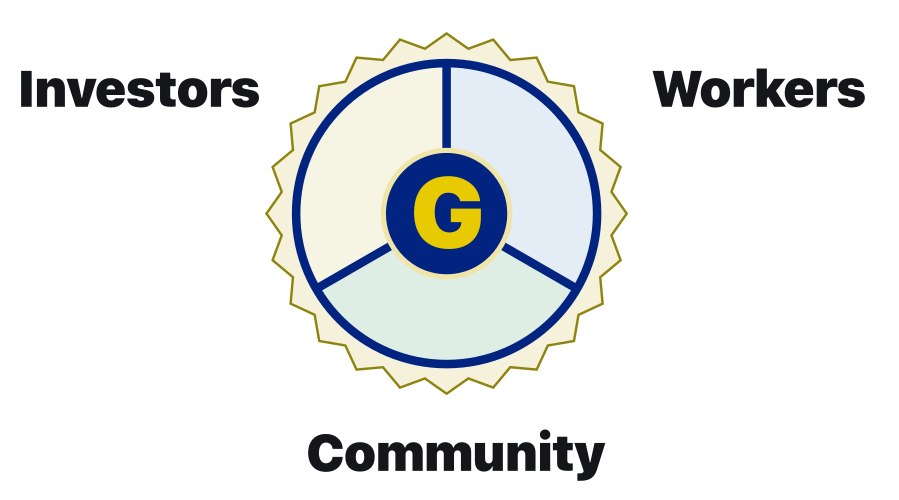
The G-Corp (aka, Commonwealth Corporation) is an elegant solution to the problem of corporate moral decay. At its core, the problem is one of ownership. When entrepreneurs trade shares of their company to investors in exchange for capital, they are giving up ownership, in both senses of the word. Once investors have bought up the majority of the shares, the entrepreneur no longer has ownership of what was once their business — and in fact, no one does. Its priorities are shaped by a diffuse set of investors, whose least-common-denominator interests drive the business to act in amoral and antisocial ways that nobody can truly control.
Some entrepreneurs recognize this intuitively and hold out from selling for a long time. But this has its own drawbacks. It can be nearly impossible for a business to grow without the infusion of capital that investors can provide. For this reason, the most ambitious founders eventually give in. Slowly at first, then more rapidly as the need for cash compounds, they sell off bits of their company’s soul.
A better structure would allow businesses to raise the capital they need to succeed while keeping hold of their “souls.” It would prevent them from ever diffusing into a least-common-denominator logic, and allow them to instead stay responsive to the human interests of their stewards and the societies that they are embedded within — to be givers and not takers. It would empower their leaders to approach business decisions with a holistic and nuanced understanding of corporate success, integrity, and longevity, and encourage them to make the appropriate tradeoffs. Finally, it would strengthen, rather than weaken, the business’s competitive edge.
G-Corps do all of this through a simple restructuring of how the business governs itself, how it relates to its community, and how it relates to government.
The G-Corp is an optional, tax-exempt corporate designation that splits corporate shares (that is, voting power and profit) across three groups: capital investors, workers, and community. Each group gets about a third of the company’s shares, so that the three each have a meaningful voice in corporate governance. And the government actually pays for the community shares directly, giving the company the capital investment it needs to be competitive.
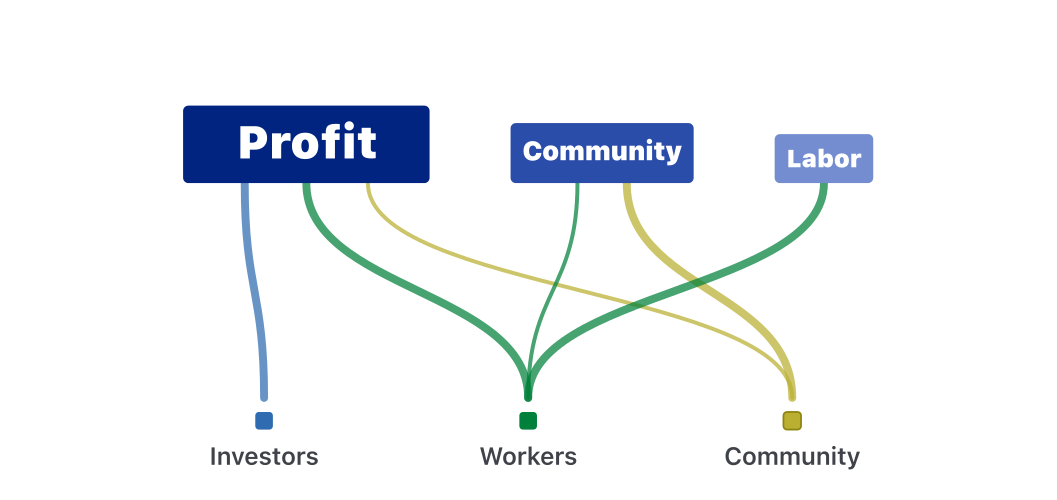
By adopting this structure, the company gets a simple and reliable source of startup cash, becomes tax-favored while retaining a profit motive, avoids adversarial labor union politics, and gets to keep its soul — the thing that gets a founder to wake up in the morning excited about the important role their business plays in the world.
I’ll explain all of this below as I describe the details of the structure. I’ll keep it as concise as possible, but there are a lot of details here — this one is for the business, economic, and policy wonks. (For everyone else: I promise next week’s proposal, The Great Boycott, will be a lot more fun!)
The G-Corp Structure
A G-Corp, like any legal business entity, is established with a charter. (You can see a sample of what a G-Corp charter might look like on the Giving America Series website, where you can also play around with how various sample businesses — like the local coffee shop MyBeanz or the mega-corp Big M Market — might fare as a G-Corp, and how G-Corps could impact the economy more broadly.)
The biggest thing that the G-Corp charter must decide is how its ownership will be split. A too-diffuse model of ownership, as I have described at length above, is both the most underestimated and most consequential failure of the modern American business model. The G-Corp structurally prevents this problem by dividing ownership into three groups, activating a natural system of checks and balances in which competing interests regularly surface and resolve. All three groups remain invested in the profit motive, but the company is constantly challenged beyond it; it retains a living and responsive soul.
The three groups are investors, workers, and community. Each of the three groups must be allocated between 20%-40% of the company’s shares; none can ever have a majority, ensuring that the three groups each maintain a meaningful voice in corporate governance.
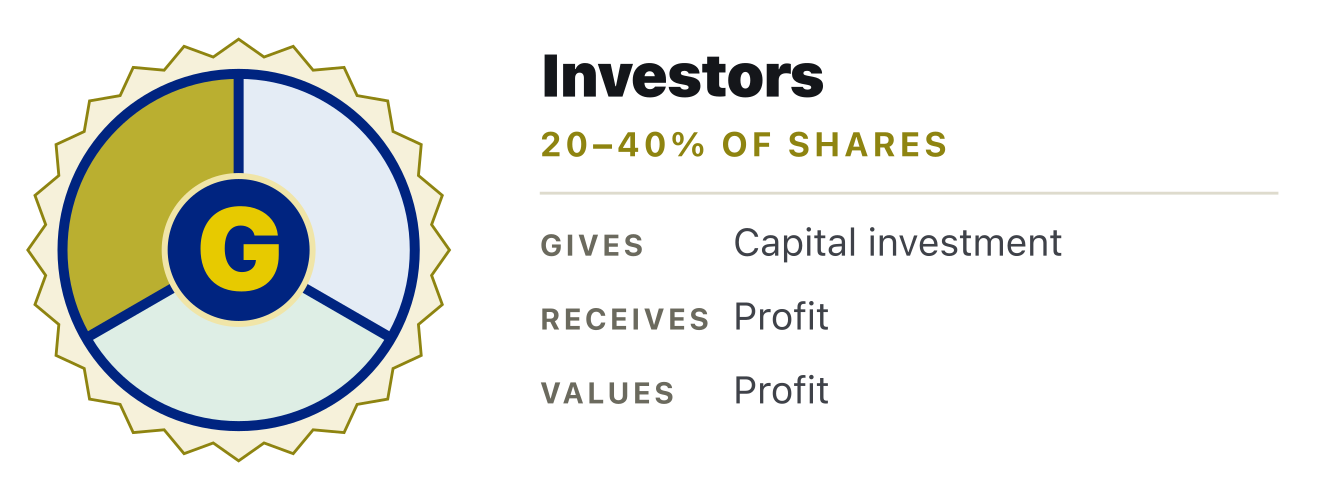
The investor slice would work almost exactly as most company shares do now, with a few benefits. Most importantly, because G-Corps would be exempt from corporate taxes, they would represent the end of double taxation. Traditionally, investors are actually taxed twice, from an economic standpoint — the company pays corporate taxes out of its profits before those profits ever reach investors, and then investors pay capital gains taxes when they sell their shares. Investors would actually make about a quarter more profit per share if they invest in a G-Corp rather than an identically-performing C-Corp. (More on corporate income taxes below.)
Additionally, to sweeten the deal, investors at the time of G-Corp formation would receive a fully uncapped QSBS-style tax exemption on the sale of stock, as long as they hold it for five years. The point of this is to incentivize founders to stay invested in their company’s success. But it also means that founders and initial investors would be not only avoiding double-taxation; they could potentially avoid taxes entirely. (More on how G-Corps are a structural improvement on taxes below and in the Q&A.)
Finally, one minor constraint: any distribution to shareholders — whether a dividend or a corporate buyback — is a single distribution event shared across all three classes in proportion to ownership. This way, whenever shareholders benefit from buybacks, it’s a windfall for the rest of us too.
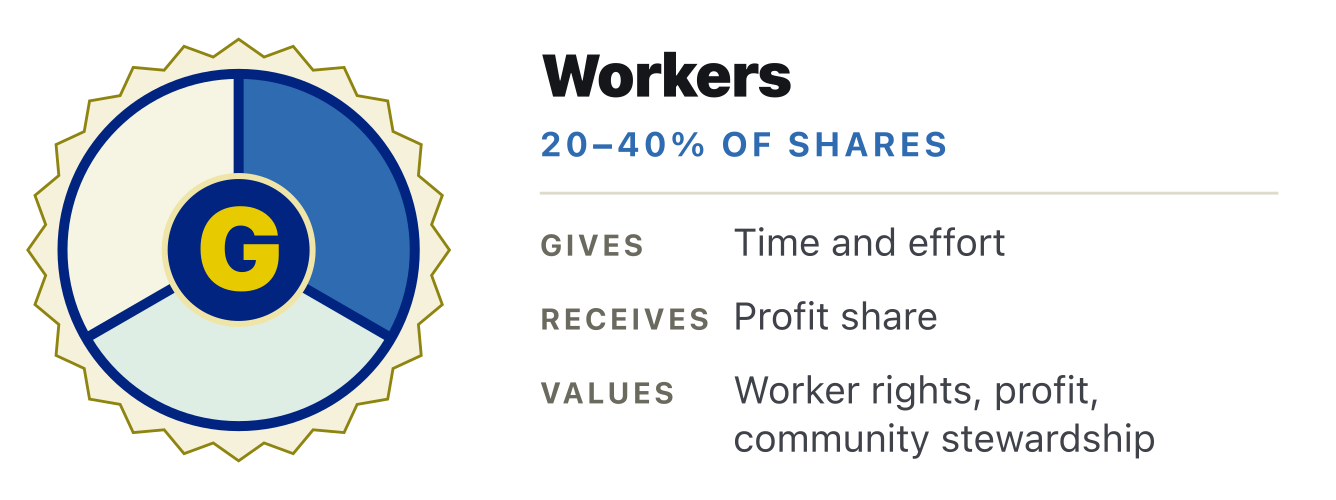
The worker slice would be split between all current employees, and would pay out dividends at an annual or shorter cadence3. (Investors would actually be compensated for these shares at fair market value, but it would happen over time. See the Q&A for more details.)
Workers would have flexibility in how they organize and use their voting power (they can and should still bargain collectively!), but the shares would be required to be distributed between workers on an hours- and tenure-weighted basis, with any contractors working meaningful hours included in the shareholding class. When new employees join, they get a share that grows with their tenure, and when employees leave, their shares rebalance into the hands of the existing workers. If there is a board, workers get to elect a share of board members proportional to their ownership share.
Workers would use their voting power to exert pressure on the company to maintain business practices that are good for employees, as well as good for consumers, to the extent that workers have strong ties to the communities that the business serves. But because worker income would be tied directly to corporate profit, workers in G-Corps would also have a strong incentive to ensure that the business is profitable. The relationship between workers and executives in a G-Corp would be utterly unlike the adversarial union/executive relationship, in which workers have little reason to value business profitability and labor contracts tend to be composed of gritted-teeth compromises and postponed pain for short-term gains. The structure of the G-Corp would genuinely bring workers and executives around to the same side of the table.4
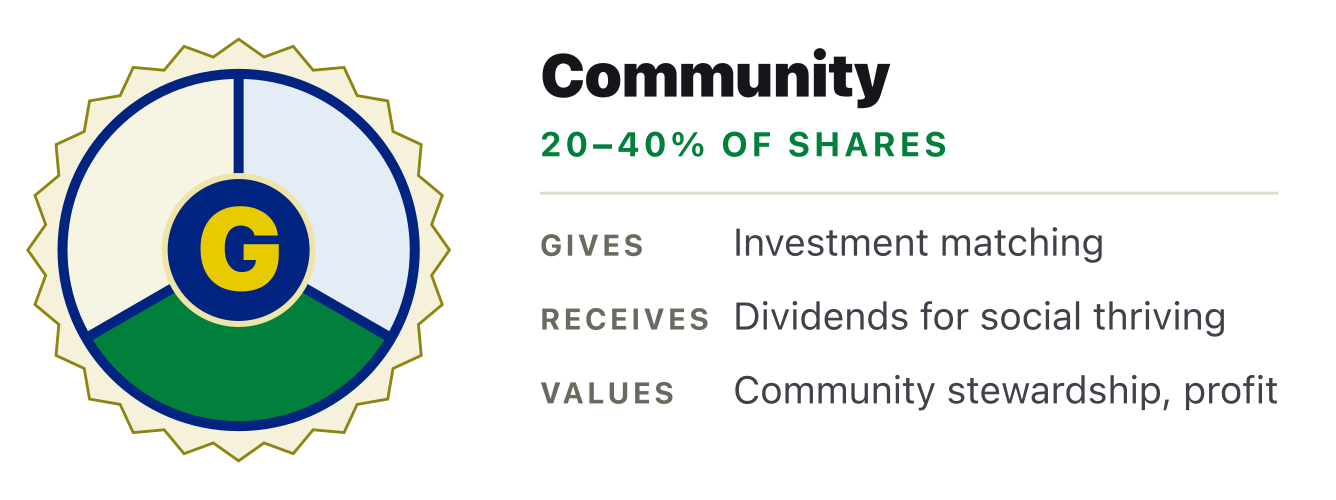
Finally, the community slice would be a special ownership structure managed by federal and state-level sovereign wealth funds. A dedicated arm of the federal Giving America Fund (GAF) would be the anchor (with a mandatory share of at least 10%), but the G-Corp’s charter could also allocate a portion of the community slice to a state-level sovereign wealth fund if one exists in its principal place of business.
As with the worker share, the community share would pay out dividends at an annual or shorter cadence, as determined by the G-Corp’s charter. These dividends would go directly into the sovereign wealth funds’ coffers, and their use would be restricted to the funds’ social expenditures exactly as described in the Giving America Fund proposal.
Funds’ voting power would be used to protect the interests of the community. Each fund would be required to establish and maintain a public charter, which could only be amended by ballot measure in their jurisdiction5 — politicians would have little-to-no control over it.
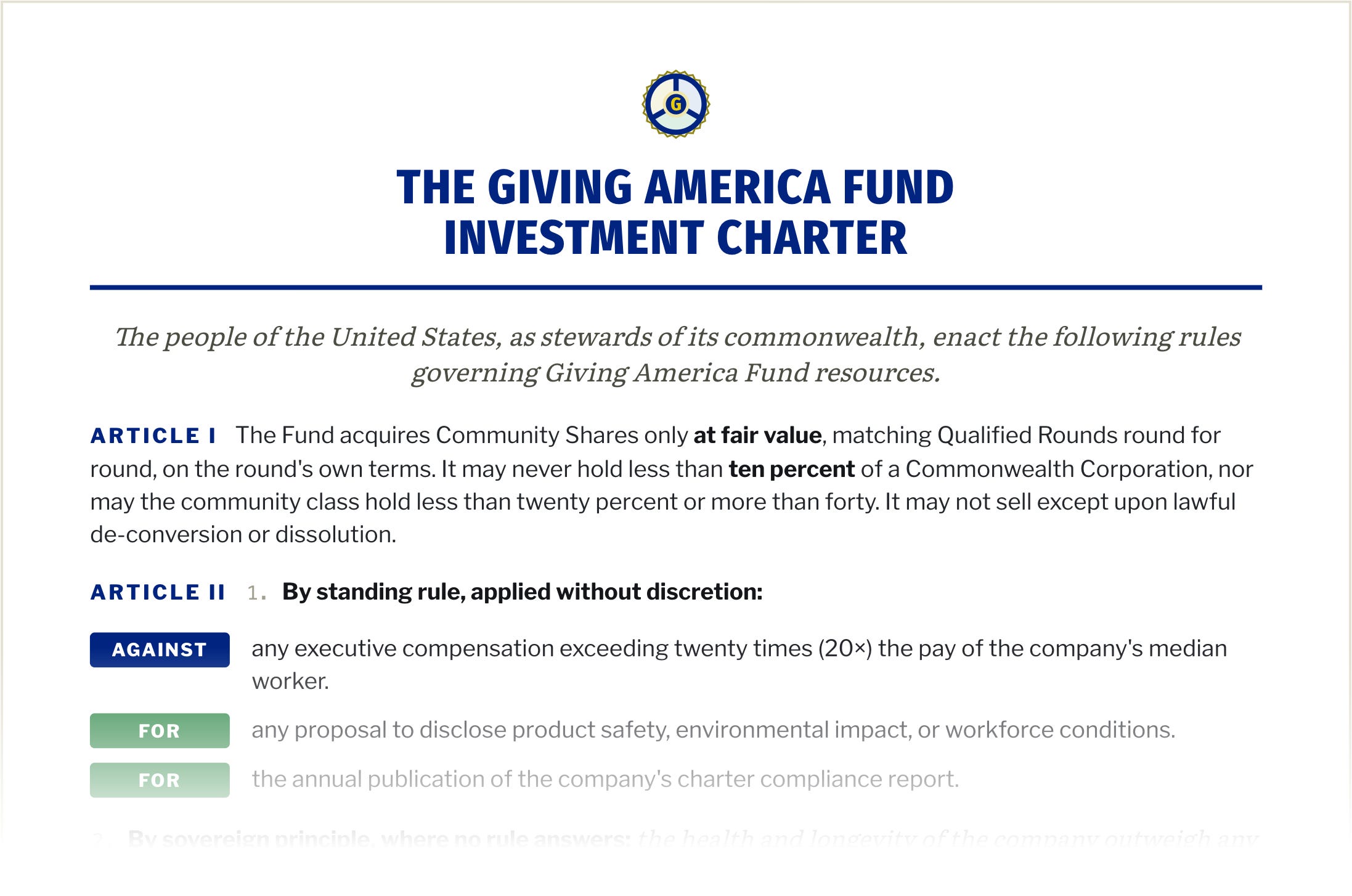
Fund charters would include two types of rules:
Mechanical rules. These could be rules on things like executive compensation (e.g. “AGAINST any executive compensation package exceeding 20x median worker compensation”), environmental and product-safety disclosure (e.g. “FOR any rule that reduces pollution of public waters”), or anything else the citizens want. They should be structured to require minimal interpretation6, so that business leaders could apply the votes themselves in most cases, and only reach out to the fund’s lean staff when there is an interpretive dispute.
Sovereign principles. These are the principles that govern votes on which there is no clear mechanical rule. Things like “The Fund favors the health and longevity of the company over any single payout,” or “A product should leave its user better off.” When a vote raises a question that the mechanical rules don’t answer7, the fund abstains on the immediate vote, and the question is referred to the fund staff, who consult the principles and publish an answer in a fund guidebook, which would govern all future votes on similar issues. Over time, this precedent would determine an ever-growing share of questions, allowing the staff to remain lean.
With this structure, the community slice is shielded from political actors and motives, and works to democratically protect the interests of citizens. And as a bonus, it creates a renewed sense of civic pride in American business — when a company in your area is a G-Corp, it really does work for you.
It also ties citizen interests to corporate success — the more profit the corporation makes, the better off the citizens’ sovereign wealth fund. Importantly, this means that the community share acts as a check not just on investors, but also on workers — fund charters are incentivized to be pro-worker to the extent that workers are part of the community, but they are also incentivized to oppose any effort by workers to enrich themselves to the detriment of the corporation’s success.
Finally, the funds would pay a fair value for the community shares. This is perhaps the most important feature of the G-Corp from a founder’s perspective. G-Corps would provide an alternative source of capital that would be both competitive with investor capital and more reliable.
The way this would work would be both mechanical and elegantly simple. The base 20% of the shares that go to the community would not be compensated directly, because they would instead be offset directly by the tax exemption. (The current corporate tax rate is 21%; so the exemption is actually worth slightly more than the shares. And if the corporate tax rate increases in the future — as I believe it should — the value proposition only improves.)
All additional community shares would be paid for directly from the Treasury, just like the GAF’s other investments (yes, we can afford this — see the Q&A). If the company is not already public, the valuation would be determined by a simple matching program — whenever a company issues shares in an arms-length investment round, the GAF buys its proportional amount of shares using the round’s valuation. With a 40/30/30 split, the community shares would essentially provide a 25% match to every investor dollar raised8. Combined with the tax exemption, this would mean that every investor dollar goes nearly 60% further, in after-tax terms, than it would in a traditional company.
Alternatively, if a founder prefers not to sell shares to investors at all, they can still access capital through community shares. If there has been no arms-length investment round, they can instead request funding based on a valuation derived from some predetermined multiple of the company’s multi-year trailing profits (or a 409A appraisal), with the capital metered out annually over time.
This way, G-Corps give founders a way to raise all the cash they need while selling as little as possible of their corporation’s soul.
Why Would Anyone Use It?
The G-Corp designation would be entirely optional. Like the LLC or the 501(c)(3) nonprofit, it would be introduced as one of many options for corporate designation. But just as the LLC grew from an experimental structure in Wyoming in 1977 to the majority choice for new business formations by the 2010s because of the flexibility it provided, I suspect the G-Corp would quickly gain traction because of its social, economic, and regulatory benefits.
We’ve discussed the social and economic benefits. On the regulatory side: I think there are a number of benefits and incentives that federal, State, and local governments can and should offer to G-Corps. For example, G-Corps can be given priority in government procurement and licensing contracts. States might even consider providing carve-outs from things like state-level data center bans for G-Corps which allocate a large enough share to the State sovereign wealth fund. This is because the relationship between a G-Corp and citizens is fundamentally different from the often-adversarial relationship that citizens have with corporations. Citizens have a say not just in how governments regulate G-Corps, but also how G-Corps regulate themselves.
And if that isn’t enough to convince you: so far, this proposal has been all carrots; but there is one stick — taxes. There is no need to impose a corporate tax on G-Corps, because a sizable portion of their profits automatically redound to the collective good. In fact, even the smallest possible community share (20%) would replace the value that the current corporate tax rate (21%) brings in the form of taxes, with the added benefit that the G-Corp profit share is much more difficult to dodge.
But we shouldn’t let the existence of G-Corps distract us from the fact that traditional corporations have been avoiding paying their fair share. In 2017, the Tax Cuts and Jobs Act slashed the corporate tax rate from its decades-long position at 35% all the way to 21%. This led to a profound increase in wealth inequality. Profits boomed for corporate investors, and that money did not trickle down. We should restore the old 35% tax rate for traditional corporations (either all at once, or phased in over time, if that’s more politically feasible). This is the right thing to do on its own, but it would also help further incentivize businesses to take on the G-Corp designation. At the standard 35% tax rate, the basic math makes G-Corps the financially-optimal choice for most businesses, notwithstanding the social and regulatory benefits (See Q&A for details).
Conclusion
The G-Corp gives businesses back their soul, by restoring their balance. It solves the problem of the runaway profit motive, gives workers true power and ownership, gives communities and citizens a voice. And it makes businesses more efficient and successful, not less, by constraining each group’s ability to leech from the others, while encouraging them to work together towards productivity for all, a healthier profit motive. In other words, it works because it is truly contributist — the corporate embodiment of all four of the contributist principles, most especially the fourth: “We believe ownership rights belong to those who give.”
You probably have questions! There is a Q&A posted as its own separate article, and you can feel free to leave comments and questions below.
As you might imagine, the board can theoretically hear the will of the shareholders by holding a vote. As you can probably also imagine, the clarity these votes provide is limited, to say the least, both because most voting is done by proxy, which means someone is voting on someone else's behalf (It's turtles all the way down!), and because the voting process is so onerous, shareholder interests so diffuse, and shareholders so uninterested in being bothered that boards will usually only take things to a vote if it is absolutely required by the charter, which generally means shareholders only ever vote on the driest procedural matters. This, of course, further reduces shareholder interest in active participation in the process.
Although, to be fair, this is also complex. Some people really are evildoers. But more often, being the agent of an amoral corporation is itself corrosive to the soul — a life spent in the practice of seeking profit at all costs on others’ behalf becomes, eventually, hard to distinguish from a life spent seeking profit at all costs for oneself.
By default, this would be some floor percentage of trailing profits, but it would be waivable by a supermajority vote of the worker and investor classes, so a growth company can retain profit when necessary.
This structure shares some features with an Employee Stock Ownership Plan (ESOP), which is a type of retirement plan that buys company shares on the behalf of workers. ESOPs also provide some precedent for the G-Corp’s tax-exempt status — the portion of any S-Corp that is owned by an ESOP is tax-exempt, because the federal government believes worker-ownership to be good public policy. But there are important differences. G-Corps are not just about profit-sharing, but also about governance — adding a meaningful worker voice to the company’s soul. For this reason, G-Corp shares remain within the company with its workers, rather than transferring out with retirees. By this and other features, the G-Corp structure resolves the structural problems that doomed United Airlines’ famous ESOP experiment.
Because there are no federal ballot measures, this would actually be harder to implement for the GAF than for state funds. I think we should probably introduce national referendums, but it might require a constitutional amendment. As a temporary alternative, we could require amendments to the GAF charter to pass by a supermajority in Congress, or we could take a page from Sweden’s law-making book, and require them to pass by “double enactment” — the same bill has to be passed by two successive Congresses to take effect.
Procedural rules could be drafted to ensure this, enforced by the fund staff.
Two types of ambiguities are answered by default: If the fund’s rules or principles are against any portion of what is being voted on, the fund votes no on the whole vote. And for votes on fundamental questions (e.g., business charter amendments, sale, conversion, relocation, or dissolution), the fund votes no by default (unless the fund has a rule explicitly stating otherwise). This is so that such votes require a supermajority of the other two groups to pass.
A few caveats here. High-dollar-value matches would be paid out over 2-3 years, to prevent overburdening the Treasury. Stage-based caps would apply, so that early stage companies with overly bullish investors wouldn’t be able to take advantage of the full match all at once if the valuation is eyebrow-raising. And “arms-length” would be defined and enforced, with clawbacks and prosecution for foul play.