

I think the biggest problem with taxes is that nobody likes paying them. I know that this sounds overly simplistic, but I promise it isn’t.
I do mean it in the simple sense: the experience of paying taxes is pretty unpleasant. Just about everyone in America knows the minor indignity of waiting for your first paycheck at a new job to figure out just how much smaller your take-home pay is than you expected. And although I actually enjoy filing my annual tax return (sometimes I feel like an unpaid spokesperson for FreeTaxUSA), I realize I’m in a very tiny minority.
But I also mean it in a much more nuanced and important way. People tend to treat taxes like NIMBYs treat housing — we’re often on board with the idea of increasing taxes on others, but we reject any suggestion of increasing taxes on ourselves. Politicians understand this, so they usually advocate for lowering taxes on whichever constituency matters the most to them, and increasing taxes on whatever constituency matters the least. Taxes thus become a game of hot potato, where whoever has political power immediately tosses the burden to someone else.
This tends to make for bad policy, but it also makes a lot of sense. Contributism actually explains the problem with taxes quite well: giving is what makes us feel fulfilled and dignified, and taxes are pretty bad as a form of giving. Across the FARE metrics — free, active, relational, and effective — taxation performs poorly on all four. Taxes are not given freely; as Chris Rock once said, “you don’t even pay taxes — they take taxes!” They’re not given actively; you usually find out about the withholding after the fact. They’re not relational; the IRS is the poster child of nameless, faceless bureaucracy. And it is increasingly hard to say that they’re effective, as we regularly hear stories of more billions of dollars spent on foreign wars of uncertain aim, while the government continues to cut essential services domestically.
It is hard to imagine a world in which taxes are truly contributist — where we feel humanized when we contribute our resources to generate socially-distributed goods and services instead of lightly exploited by them. But I think this is a failure of our collective imagination. What I like about contributism is that it provides the language for us to understand problems that are otherwise obscure to us — and to think of solutions.
I don’t think there’s a single solution that will remake taxes into something fully contributist, but there are a number of things that can be done, at all levels of government, to shift our economic relationship with the government into something more politically healthy. The previous proposal in the Giving America series, Participatory Budgeting, aims at making a portion of our tax contribution more free, active, and relational. The proposal before that, G-Corps, would give corporations the free choice to replace taxation with a more direct social profit-sharing structure. And the Giving America Fund would tie funding for social spending to the prosperity of the economy itself, rather than relying on post-hoc extraction from investors.
Today’s proposal would be a step towards making our taxes more active, relational, and effective.
Proposal: Tax Report Cards
I think every government that collects a broad-based tax (property or income tax; city, state, and federal) should be required to provide an annual report card to each taxpayer, detailing where their taxes go. At minimum, these report cards should detail where every dollar the taxpayer contributed went that year. At best, the report card would be the first step in allowing taxpayers to clearly indicate their spending interests to the government, and to have a direct, meaningful say in where their tax dollars go.
Tax report cards are not a new idea: the UK and Australia have both been doing it for about a decade.
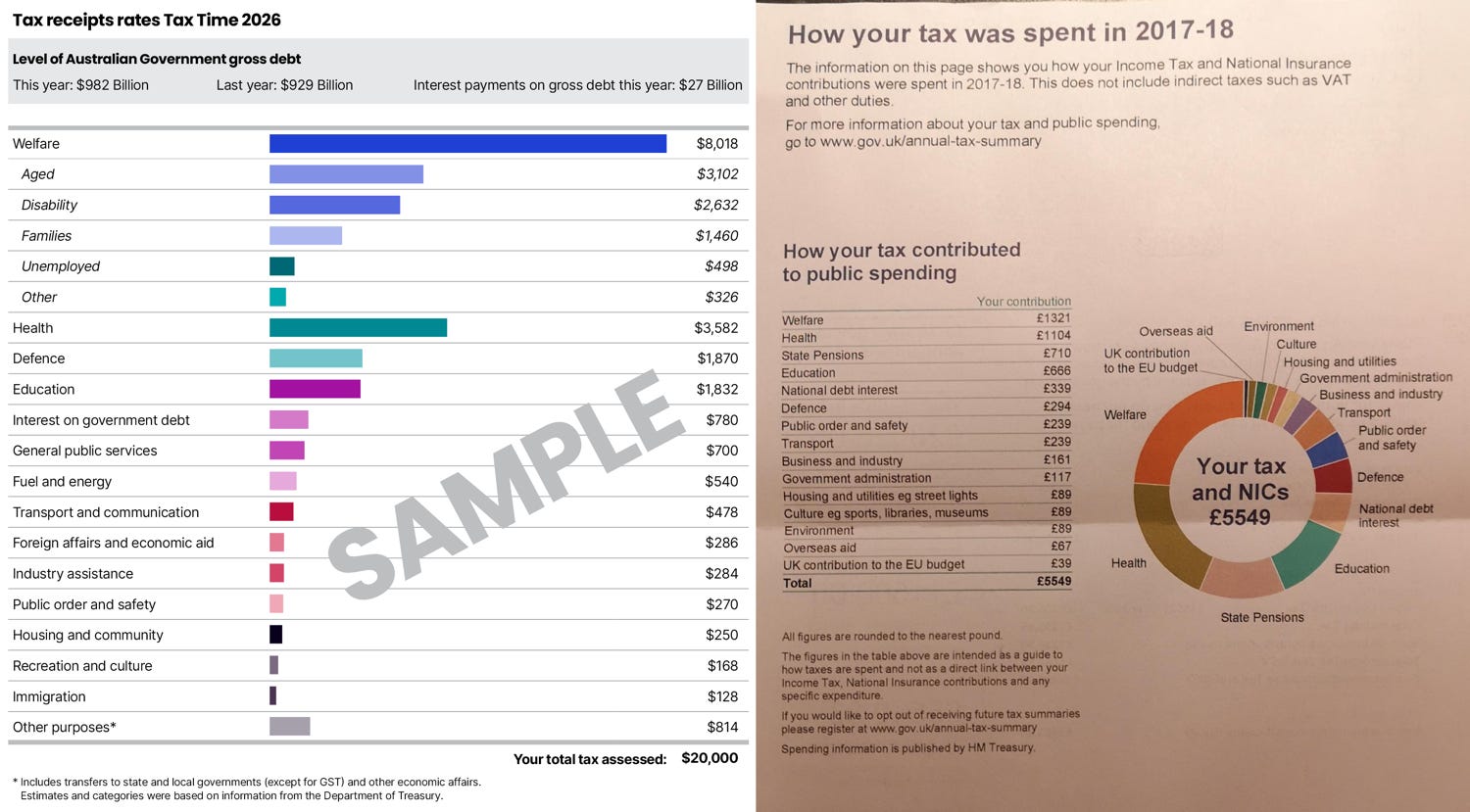
I think both of these report cards are great. They are clearly communicated, aesthetically pleasing, and simple enough to fit on one page. And they are personal — they reflect the allocation of the individual taxpayer’s total contribution, which is more comprehensible than the hundreds of billions of dollars that comprise overall spending.
Notably, the fine print on the UK summary indicates that this is not an exercise in tracing the individual taxpayer’s dollars through the government’s financial systems, but a back-fitting of aggregate government spending to the individual’s total contribution. I think this is actually the more honest route. Even if an individual’s particular dollars could be traced all the way from collection to their specific destination, I don’t think that would be as useful to know. I think what taxpayers really deserve to see is a holistic picture of how the government is allocating the funds of taxpayers like them.
And this would be as good for governments as it is for taxpayers. It’s an opportunity to clear up misconceptions and restore a sense of legitimacy to the government’s work. As a pointed example, I think DOGE might have been less eager to slash agencies like USAID if it was common knowledge that foreign aid made up less than 1% of government spending. And I think we all might care a bit more about the federal debt if we received an annual reminder of how much of our taxpayer dollars each year go to paying its interest (the fastest-growing major category in the federal budget!). Ignorance breeds both conspiracy and negligence; transparency would help make the government’s spending more robust.
It is also an opportunity for governments to highlight their successes. In both the UK and Australia, the report cards are federal, and at the federal level, there are of course limits to how much detail these report cards can include. As things get more local, though, there is more opportunity to get specific. States can use these report cards to highlight programs that they think their constituencies should know about, and cities could even trace spending to specific events or milestones (“300 potholes filled!”). At every level of government, the card could display how many teachers, nurses, inspectors and soldiers your money employs. The associated website could include personal interest stories about the recipients of government funding. And of course, any jurisdiction that implements participatory budgeting should include in their report how their taxpayer’s project money was spent.
That’s the baseline; I think every jurisdiction which collects income or property tax should implement something like this.
But the report card can go further. The card should link to a website where taxpayers can adjust some toggles and submit their suggestions on how they would like their dollars to be spent next year. This would be zero-sum, so they would have to choose what to decrease here in order to increase there. (You can see an example of how this would work on our website.) I don’t think legislatures should be required to honor these preferences, but I think they should see them. Legislatures should know if, in aggregate, taxpayers would prefer the education spending to be increased to 12% and environmental spending decreased to 3%.
After adding these taxpayer suggestions, we can go one step further, if we have the public will. These could become true report cards — it could be mandated by law that governments send them, and they could include a letter grade showing how closely their spending adheres to the public will.
Done well, tax report cards would allow taxpayers to be more informed about their taxes, and feel more actively involved in the process, while allowing legislatures to be more effectively responsive to their constituents. They would create a stronger sense of accountability in the government, and a stronger sense of ownership in taxpayers.
Q&A
How would the report card be delivered?
Ideally, it should be mailed to taxpayers on an annual basis. But there are also no-cost options:
The IRS income tax return site could display it as a receipt directly after you file your federal income taxes. This would have the added bonus of allowing you to submit your suggestions directly. (Imagine how satisfying it could be for the last step of your tax filing process to be telling the government how it should spend your money.)
Local jurisdictions could include the report card on your property tax bill, which they send annually anyway.
Have we ever tried this before?
Yes and no. The Obama administration created a short-lived webpage that allowed you to input your tax information and see a “federal tax receipt” showing your tax allocations. But I would honestly be surprised if you had heard of it. The crucial difference here is that the report card would be sent out to taxpayers proactively; everyone would see it, whereas almost nobody saw the Obama website.
Would governments really listen to our suggestions?
Politicians are ultimately creatures of popular instinct. They use the information that’s available to them to craft platforms that they expect will help them to gain support. Not every politician would be interested in the aggregate interests of their constituents, but some would. If politicians could point to a graph that says “we want more education spending” and say “I’m the one who will give you what you want!,” I bet some of them would. (And for those who wouldn’t, reporters and advocacy groups could hold that same graph up to them and ask them “why not?”). The report card would allow us to make that graph.